
Best Trampolines 2026: Our Picks by Use Case
Last updated: May 15, 2026 · By ProTrampolines
We earn a commission if you buy through the Amazon links on this page. It doesn’t change the price you pay or the scores below.
We’ve reviewed trampolines since 2011. We score each one by its weakest component, because a trampoline is only as strong as its weakest part. That’s the principle behind our PT Score, a six-component scale that takes the lowest of Frame, Springs, Mat, Enclosure, Warranty, and Value, rather than averaging them out so a 9-rated frame can hide a 4-rated warranty. The list below is the nine trampolines we’d actually buy in 2026, one per use case, with our strongest all-round picks first. There’s a Best Overall, a Best Premium Rectangle, a Best Premium Round, a Best In-Ground, a Best Budget, a Best Mid-Range Round, a Best for Kids, a Best Mini Rebounder, and a Best Springless. If you only have time for one section, the comparison table just below has the headline numbers.
How we scored these
PT Score is a 0-to-10 scale built from six components: Frame, Springs, Mat, Enclosure, Warranty, and Value. We don’t average them. We take the MIN, because the weakest part of a trampoline is the part that fails first, and that’s the one that determines whether you’re shopping for a replacement in year three or year ten. A brand that won’t publish the specs that let us verify a component can’t earn top marks on it; transparency is part of what we grade, because a number you can check beats marketing copy you can’t. The methodology is documented in full at our scoring page, and every pick below links out to the full review where you’ll see the per-component breakdown.
At-a-glance comparison
| # | Best For | Model | Shape / Size | Total Weight Limit | Warranty (frame) | PT Score | Limiting | Tier | Check Price |
|---|---|---|---|---|---|---|---|---|---|
| 1 | Overall | Galactic Xtreme 10×17 | Rectangle 10×17 ft | 750 lb structural | LIFETIME | 7.6 | Warranty | $$ | Amazon |
| 2 | Premium Rectangle | ACON X 17ft | Rectangle 17 ft | 3,000 lb structural | 10 yr | 7.8 | Value | $$$ | Amazon |
| 3 | Premium Round | Jumpflex HERO 14ft | Round 14 ft | 550 lb structural | 10 yr | 6.6 | Frame | $$ | Amazon |
| 4 | In-Ground | BERG Champion InGround 14ft | Round 14 ft (430 cm) | 600 kg structural | 10 yr (13 with registration) | 6.5 | Frame | $$$ | Amazon |
| 5 | Springless | Springfree 8×13 ft Large Oval | Oval 8×13 ft | 1,500 lb structural | 10 yr (all components) | ~6.0 | Frame | $$$ | Amazon |
| 6 | Mid-Range Round | AlleyOOP 14ft PowerBounce | Round 14 ft | 267 lb per jumper | LIFETIME | 6.5 | Value | $$$ | Amazon |
| 7 | Budget | JumpYeti 14ft | Round 14 ft | 450 lb total | 1 yr (whole product) | 5.8 | Springs | $ | Amazon |
| 8 | For Kids | Skywalker 60″ Mini (Spaceship) | Round 60 in mini | 100 lb per jumper | 3 yr frame / 1 yr other | 6.0 | Mat | $$ | Amazon |
| 9 | Mini / Adult Fitness | Fit Bounce Pro II | Mini rebounder 40 in | 308 lb / 140 kg | Lifetime frame | 6.0 | Mat | $$ | Amazon |
A note on prices. We don’t quote live figures because they move every week, and a stale price in a review is worse than tier language. The “Check Price” buttons go to Amazon. If you buy through one, we earn a commission. It doesn’t change the price you pay or how we score. Prose may reference manufacturer MSRP for context.
#1. Galactic Xtreme 10×17: Best Overall
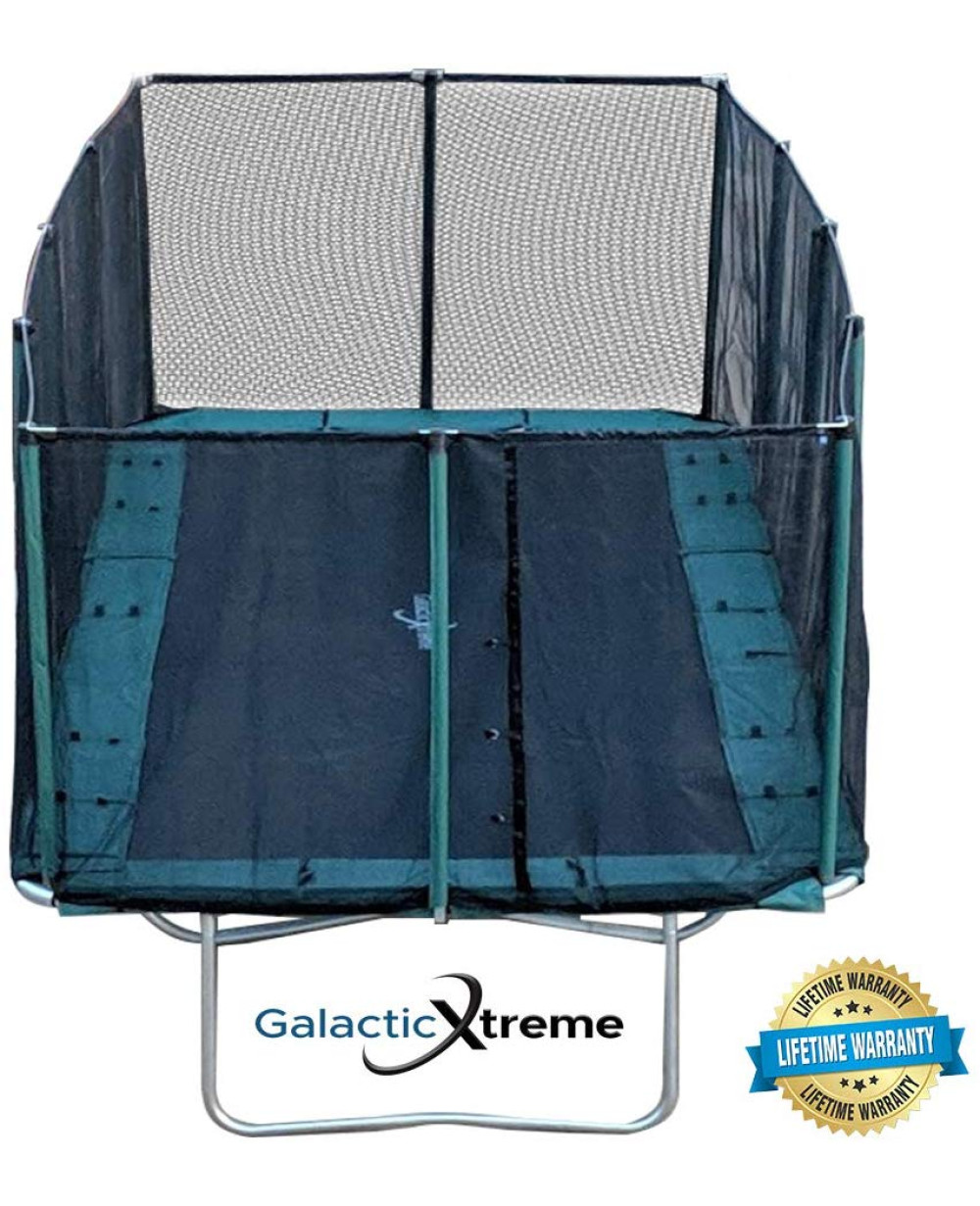
PT Score: 7.6 / 10 · Limiting: Warranty · Tier: $$
The Galactic Xtreme 10×17 is the trampoline that quietly publishes more than the European premiums do, and the numbers stack up. It’s the house brand of Happy Trampoline, a California company that’s been selling commercial-grade rectangles since 1996, and it’s the only premium rectangle in our test set that actually publishes its frame steel-wall gauge. The headline numbers: 3.0 mm steel walls (9 gauge, hot-dipped galvanized inside and out), 124 fully galvanized 9-inch coil springs, a USA-made Grade A Permatron mat, a 9.5-foot net with dual zipper entries, and LIFETIME warranties on both the frame and the springs. On Amazon, it usually lands between $800 and $1,200, which puts it well below the $1,500 mid-premium tier where the ACON Air 16 Sport HD sits and roughly a third the price of an AlleyOOP PowerBounce 10×17.
Pros
- Published 3.0 mm frame wall gauge; nobody else in the premium rectangle field discloses this number
- Lifetime warranty on frame AND springs; class-leading at any price tier
- 124 fully galvanized coil springs at 9 inches (longer and more of them than most premium rivals)
- 9.5-foot net with dual zipper-plus-buckle entries, foam-padded steel poles
- 550 lb per-jumper rating (generous; most premiums cap at 220-350 lbs)
Cons
- 2-year warranty on mat, pad, and net is industry-typical-short (ACON gives 5 on the mat)
- 30-year brand history is real but shorter than BERG’s 70 or ACON’s 27 of design-led marketing
- Amazon distribution is messy: same product sold under several seller names
- Marketing copy occasionally references “piano-wire” springs, which it doesn’t actually use (heavy-duty galvanized coil, not high-carbon music wire)
- Fixed deck height and fixed bounce stiffness; no adjustability
Why it earned Best Overall: It posts one of the two highest scores in this guide, and the limiting factor is warranty, not a safety-critical component. The 2-year mat coverage drags the score down, but mat material is the part of a trampoline you’re least worried about long-term (polypropylene mats in this construction typically outlast their warranty by years). The frame and the springs, the two parts you genuinely don’t want to fail, are covered for life. For a spec-driven buyer who’s already cross-shopped the field and noticed how much European-brand premium is paid in brand history rather than published spec, this is the obvious cross-shop.
Check Price on Amazon
Read the full review
#2. ACON X 17ft: Best Premium Rectangle
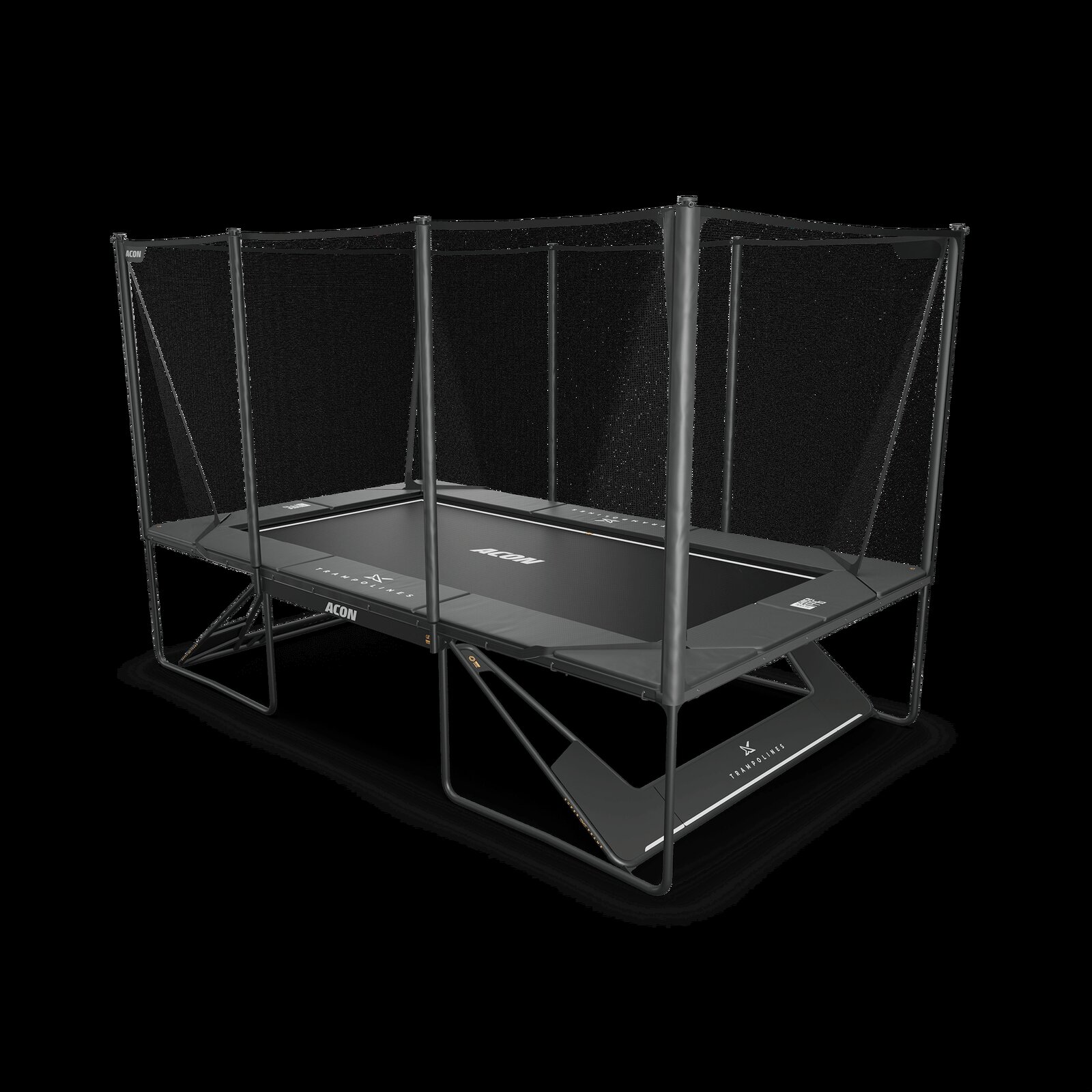
PT Score: 7.8 / 10 · Limiting: Value · Tier: $$$
The ACON X is the trampoline ACON builds when it stops thinking about backyards and starts thinking about gymnasts. It’s the top of the Finnish brand’s range (Oulu for design, China for manufacturing under ACON’s quality oversight), and it’s the one rectangle we’ve reviewed with a genuinely differentiated feature set: a rigid Super X-Frame, a patent-pending “zero-gap” enclosure that seals to the frame, 120 X Performance Springs at 9.6 inches, and (the headline) three deck heights covering toddler, standard, and full performance use cases. ACON developed the X line in partnership with Olympic-level gymnasts, and the 4-foot performance deck is what justifies that pitch. Available in both Black and Light Grey. Price is roughly $4,099 on Amazon, slightly above ACON’s $3,999 MSRP. There’s no bargain hiding anywhere on this one.
Pros
- 3-way adjustable deck height (2 ft toddler / 3.5 ft standard / 4 ft performance with kit) is genuinely unique in this segment
- Patent-pending zero-gap enclosure seals to the frame; no spring-zone gap for limbs
- 5-year spring warranty is at the top of the residential market
- Cross-sewn polypropylene mat with 10 rows of UV-treated stitching, also 5-year cover
- 661 lb shipping weight signals serious frame engineering; 3,000 lb structural rating
Cons
- Premium-tier money at either store, about $4,099 on Amazon, with no discount to chase
- ACON keeps a thin spec sheet: the frame tube gauge, the enclosure pole count, and the net mesh material aren’t published
- 2-year safety-pad warranty is the short leg of ACON’s table; budget for a pad replacement around the 2-to-4-year mark
- Designed in Finland, built in China; matters if you’re specifically paying for European manufacture
- Specific ASTM standard numbers aren’t cited, just “ASTM-certified” and “CE-certified”
Why it earned Best Premium Rectangle: For a mixed-age family or a serious backyard gymnast, no other rectangle does what the X does. The adjustable deck height turns one trampoline into three (toddler at 80 lb cap, standard at 260 lb, performance at 330 lb with the kit), and the zero-gap enclosure is the most differentiated safety feature on any rectangle we cover. At 7.8 it’s the top-scoring rectangle we cover; what holds it back from a clean sweep is the price, not the build. If the budget is there, it’s the rectangle to buy.
Check Price on Amazon
Read the full review
#3. Jumpflex HERO 14ft: Best Premium Round
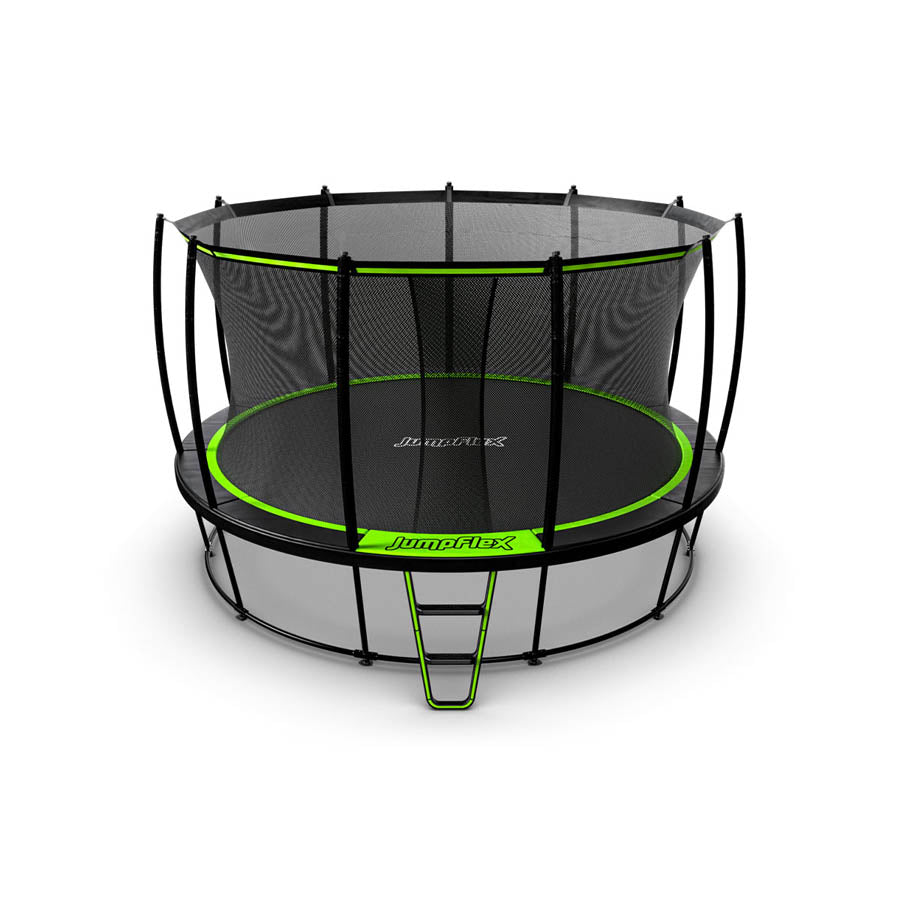
PT Score: 6.6 / 10 · Limiting: Frame · Tier: $$
Jumpflex is the New Zealand brand most American buyers haven’t heard of yet, and the HERO is the product about to change that. Designed and engineered in Hamilton, NZ since 2009 and built in China under Jumpflex’s own quality oversight, the HERO line pushed into the US Amazon market in 2024 and 2025. The hook is the frame: a no-bolt, no-weld snap-together system Jumpflex calls FrameFusion, which won an Australian Good Design Award and lets a 14-footer go together in about 20 minutes with no tools at all. The DualRing layout pairs a 42 mm upper ring with a 38 mm lower ring; 88 high-tensile galvanized springs ring a 12.1 ft mat, and the curved foam-sleeved poles plus a self-closing zip entrance round out a thoughtful safety package. Around $900 on sale, $1,199 at list.
Pros
- FrameFusion no-bolt frame: tool-free build in roughly 20 minutes (the frame; the net takes longer)
- Won the Australian Good Design Award for the frame engineering
- Curved foam-sleeved poles lean away from the jumper; self-closing SafeSeal zip entry
- 350 lb per-jumper limit, generous for a 14 ft round
- Net and ladder included in the box, no $100-$200 add-on surprise
Cons
- The snap-together FrameFusion frame is genuinely new and genuinely unproven: no decade of field data behind it the way bolt-and-weld frames have, and Jumpflex doesn’t publish the steel wall gauge
- The “patented” frame claim doesn’t hold up to USPTO, NZ, or AU patent searches; the Australian Good Design Award is the credential that does check out
- Newer brand with a thinner spec sheet than ACON or BERG; mat fibre and stitch-row count aren’t published either
- 88 springs at 7.1 inches is family-grade rebound, not gymnastics-tier
- At the $1,199 list price the value case thins; this is a trampoline to buy on sale
Why it earned Best Premium Round: On sale around $900, the HERO is hard to beat for a buyer who wants a premium-feeling 14ft round without ACON or AlleyOOP money: net and ladder in the box, a 20-minute tool-free build, and a 10-year frame warranty. The FrameFusion frame is the boldest thing about it, and also the biggest open question. It’s a genuine engineering idea, and the Australian Good Design Award is a real credential, but snap-together construction is new enough that long-term durability is still a bet, and the 10-year warranty is what backs that bet. Cross-shopped against a Zupapa, the HERO costs roughly twice as much, builds in a fraction of the time, and feels a real step up. Buy it on sale; at $1,199 list the value case thins.
Check Price on Amazon
Read the full review
#4. BERG Champion InGround 14ft: Best In-Ground
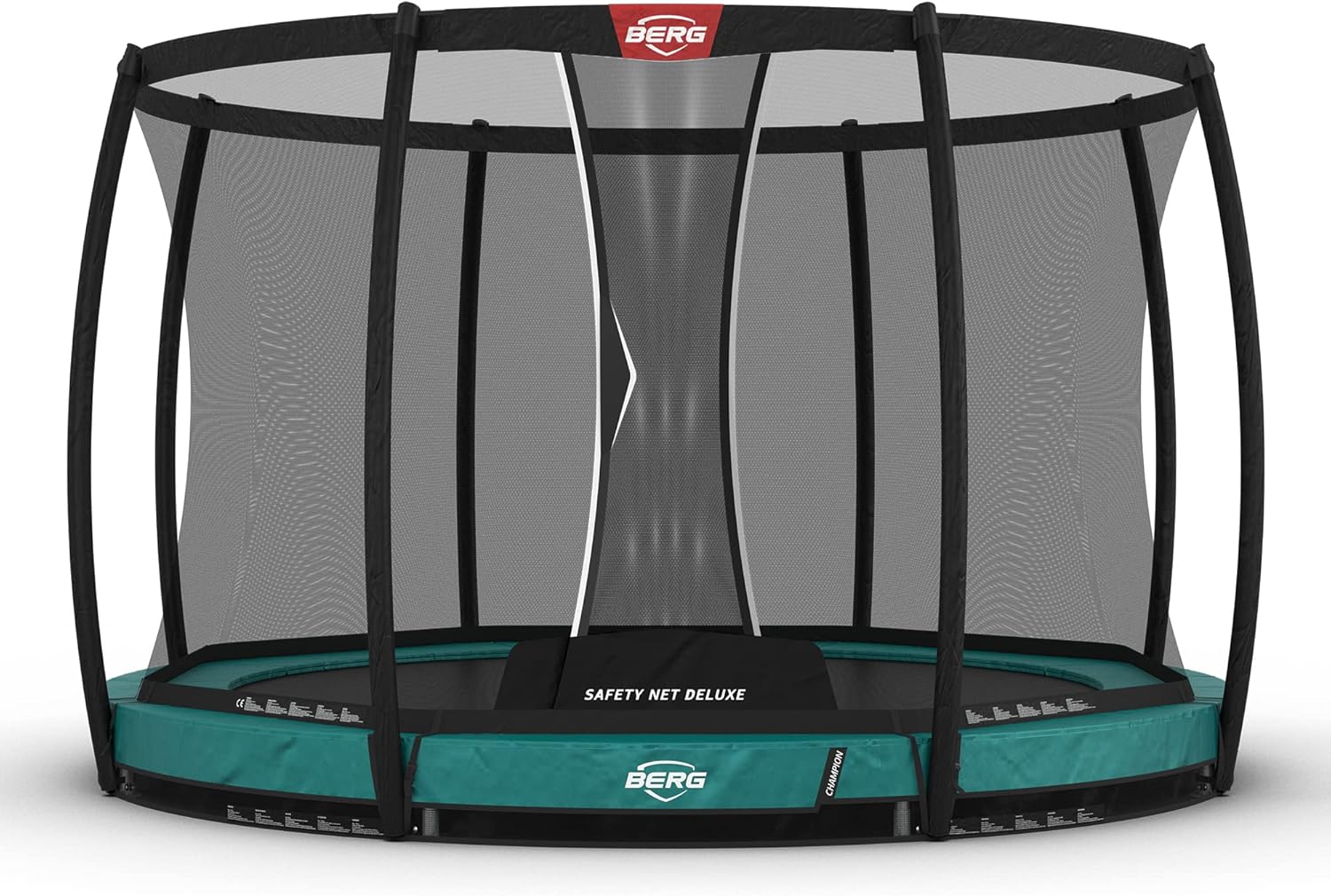
PT Score: 6.5 / 10 · Limiting: Frame · Tier: $$$
An in-ground trampoline isn’t really a different product so much as a different decision. Before you’ve picked a brand, you’ve already agreed to dig a hole in your garden, manage the drainage, and live with a frame that sits a hand’s width above the lawn rather than waist-high on legs. The BERG Champion InGround 14ft is one of the better-engineered ways to act on that decision, and at 430 cm across it’s also the size two kids can use without colliding. BERG Toys is a Dutch company, designing and building in Ede in the Netherlands since 1985, which makes them a rarity in this market: a brand that engineers and manufactures in the same place. The 14ft is the Champion InGround that BERG actually sells through Amazon US (the smaller 11ft is direct-purchase only), so it’s the practical choice for most American buyers in this line. The Amazon listing we link to is the “+ Safety Net Deluxe” bundle; double-check the listing title since BERG sells some Champion configs with the simpler Comfort net or frame-only.
Pros
- TwinSpring Gold paired V-shape springs, fully galvanized, generous count for a 430 cm frame
- AirFlow vented mat solves the trapped-air dead-bounce problem that kills cheap in-ground conversions
- 10-year frame warranty extends to 13 years with free registration on berg.com (class-leading)
- 120 kg / 265 lb per-jumper limit, 600 kg structural
- Designed and built in Ede, Netherlands (rare in this category)
Cons
- The dig is the real project; a 430 cm bowl-shaped pit needs a mini-digger or a landscaper
- Drainage is your problem to solve; BERG’s manual isn’t especially detailed on it
- Not flush with the lawn; the top rail sits about 20 cm proud
- BERG publishes less than the price suggests: the frame wall gauge, the mat fibre, the exact 14ft spring count, and the pole count are all off the spec sheet
- Mat, pad, and net warranties all just 2 years (lopsided against the 10-13 year frame cover)
Why it earned Best In-Ground: For a buyer who’s already committed to the in-ground approach, the Champion InGround 14ft is one of the best-engineered ways to act on that decision, and the things it does well (the TwinSpring Gold count, the AirFlow mat, the 13-year registered frame warranty) are the things that matter for a long-haul installation. BERG keeps a thinner spec sheet than the price suggests, but a 40-year company that designs and builds in-house in the Netherlands, with a 13-year registered frame warranty, has earned the benefit of the doubt on the steel. Go in knowing the hole is the project, and the drainage is the risk.
Check Price on Amazon
Read the full review
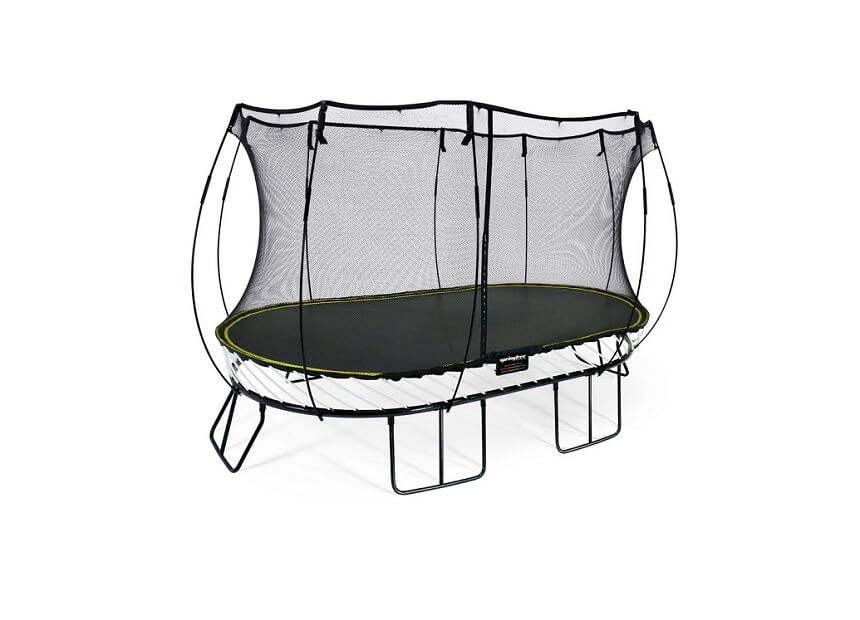
#5. Springfree 8×13 ft Large Oval: Best Springless
PT Score: ~6.0 / 10 · Limiting: Frame · Tier: $$$
Springfree throws the whole premise out. There are no metal springs at all. The frame sits roughly 450 mm (18 inches) BELOW the jumping surface, so a jumper can’t land on it. Curved composite fiberglass rods articulate from the hidden frame upward through sleeves in the mat edge, replacing every coil spring on a conventional trampoline. The SoftEdge mat eliminates the gap between mat surface and enclosure, so there’s no spring-pad to slide off. The FlexiNet uses flexible composite rods rather than rigid steel poles, so jumpers who hit the net are cushioned back to centre instead of bouncing off a steel surface. It’s a vertical manufacturer (designed by Dr. Keith Alexander at the University of Canterbury starting in 1989; commercialized through Steve Holmes), not an importer with a logo. We’ve reviewed the Springfree 8×13 ft Large Oval, the bigger of the two oval sizes, at 73 sq ft of jumping surface with the SoftEdge mat, 220 lb per-jumper limit, 1,500 lb structural, and ten years of warranty on every single component (yes, even the mat and the net). Sale price typically lands between $1,500 and $1,800 depending on bundle and season.
Pros
- Three injury zones genuinely removed by design: no springs to pinch, no frame to fall on, no spring-pad gap at the mat edge
- 10-year warranty across ALL components (frame, rods, mat, net, poles, pads) is the strongest in the category
- SoftEdge mat tested to 3 million jumps and 1,500 lbs of static load
- Composite rods don’t rust or corrode; FlexiNet’s flexible poles cushion wayward jumpers back to centre
- Springfree is a vertical manufacturer with its own IP (the only one in this list)
Cons
- The widely-marketed “90% injury reduction” headline doesn’t match the underlying study. The peer-reviewed source (Eager et al., 2012, Journal of Paediatrics and Child Health, PMC3505799) actually found 35% reduction vs US trampolines and 80% reduction vs Australian-spec models. The study was industry-funded and co-authored by Dr. Alexander, the trampoline’s inventor. Real safety benefit, but the 90% figure overstates it.
- Bounce feel is softer and less responsive than any spring system; performance-focused buyers will notice immediately
- Premium-tier price; the 8×13 Large Oval typically lands $400-$700 above a comparable spring-based mid-tier round of similar footprint
- Repair parts are proprietary; broken rods aren’t a $5 commodity item like steel springs
- Springfree publishes neither the frame tube dimensions nor, for most sizes, the rod count; a thin spec sheet for a premium product
Why it earned Best Springless: The structural safety advantages (no springs to pinch, no frame to fall on, no gap at the mat edge) are verifiable from first principles, independent of the contested headline figure. For a safety-first family that’ll trade some bounce response for genuine injury-zone elimination, this is the trampoline. The 10-year uniform warranty across every component is best-in-class. Just go in citing the actual research, not the marketing headline.
Check Price on Amazon
Read the full review
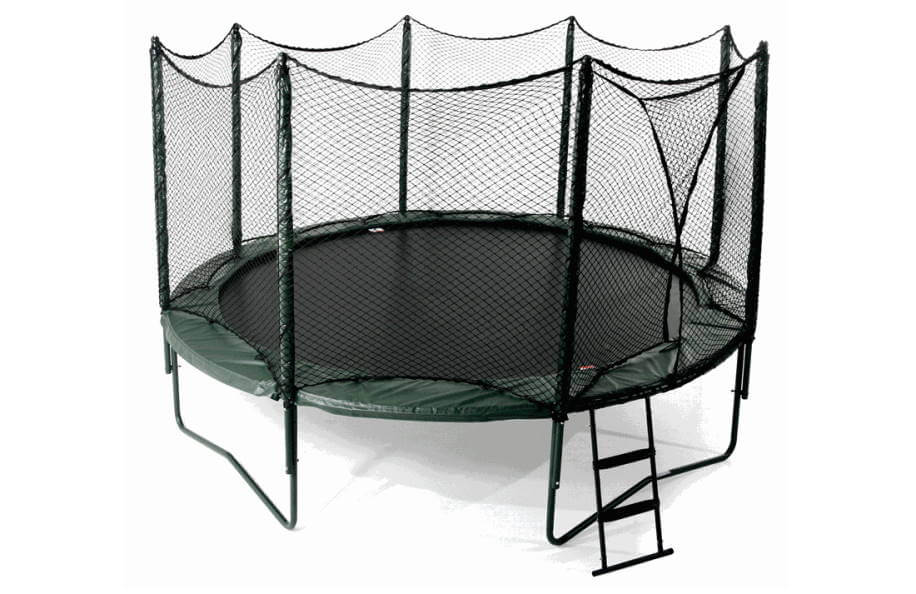
#6. AlleyOOP 14ft PowerBounce: Best Mid-Range Round
PT Score: 6.5 / 10 · Limiting: Value · Tier: $$$
⚠️ Currently out of stock on Amazon. Click through to set a price alert and we’ll notify you when stock returns.
AlleyOOP (made by JumpSport) is the round-trampoline brand that’s been doing tunable spring tension longer than anyone else in the residential market. The 14ft PowerBounce runs 144 springs total: 96 primary 8.5-inch zinc-plated coils plus 48 shorter high-carbon piano-wire PowerSprings on adjustable PowerArm assemblies, with three firmness settings (top, middle, bottom). The frame is a 1.9-2 inch top rail with 2 mm walls, cold-rolled and pre-galvanized inside and out, with a forest-green textured powder coat over the top. Mat is JumpSport Permatron with 10 rows of stitching, the same construction you’ll find on the Galactic Xtreme. The lifetime frame warranty is one of the strongest in the round category. Around $1,699-$1,899.
Pros
- Three adjustable PowerArm firmness settings (genuinely tunable bounce, not just a deck-height swap)
- Lifetime frame AND lifetime enclosure pole warranty, 5-year springs and mat
- 144 total springs is the highest count in the 14ft round field
- 8 pre-galvanized powder-coated enclosure poles; overlapping no-zipper patented door
- Owner reports cite 15-20 year lifespans with parts still available; strong JumpSport customer service
Cons
- Premium-tier money for a 14ft round; you’re paying nearly Galactic Xtreme money for a smaller round than the Galactic Xtreme 10×17 rectangle
- The PowerBounce assemblies only meaningfully engage above about 80 lb of jumper weight, so the adjustability is wasted on younger kids
- Enclosure netting quality is the recurring owner complaint (gap between net and mat edge in some configurations)
- Assembly manual praised by nobody; the assembly videos are what owners actually use
- DoubleBounce variant exists (a second mat creating an air-cushion zone) but costs another $400-$700 on top
Why it earned Best Mid-Range Round: For a buyer who wants the adjustability and the lifetime frame cover and is happy to spend ACON money on a round shape, the AlleyOOP is the pick. The three-setting PowerBounce system isn’t a gimmick; it’s a real performance feature nothing else in the residential round market matches. Value is the soft spot: the price is premium-tier despite this being a 14ft round rather than a 17ft rectangle, and if you can stretch to the Galactic Xtreme 10×17 you’ll get more trampoline for less money. If 14ft is the size you need and you want the longest warranty in the round category, AlleyOOP earns the spot.
Check Price on Amazon
Read the full review
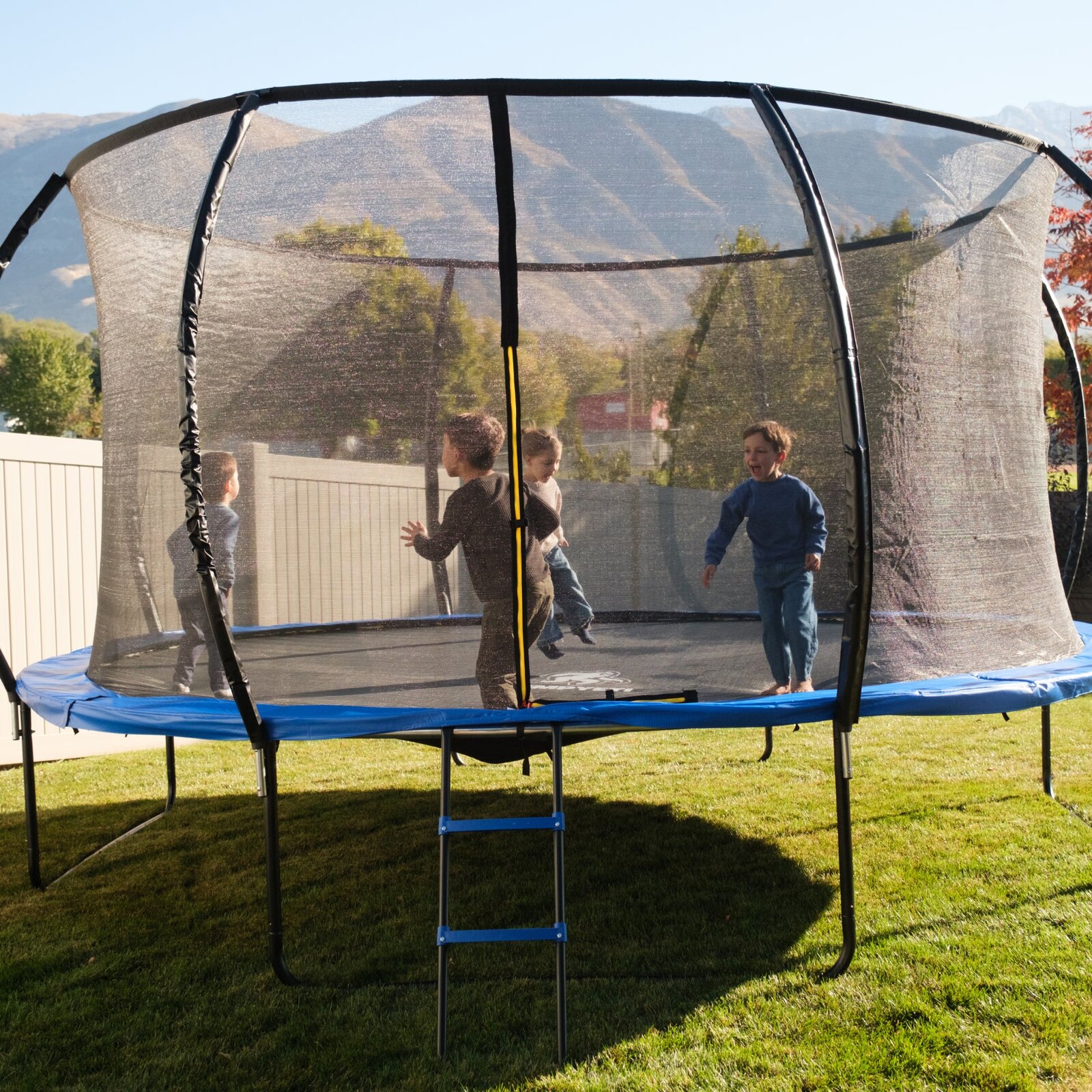
#7. JumpYeti 14ft: Best Budget
PT Score: 5.8 / 10 · Limiting: Springs · Tier: $
⚠️ Currently out of stock on Amazon. Click through to set a price alert and we’ll notify you when stock returns.
JumpYeti is the honest budget pick, and we want to flag what that means before you click anywhere. This is the lowest score in our list, and the reason is exactly what our methodology is built to catch: JumpYeti publishes almost nothing. No spring count, no spring length, no spring type, no frame outer diameter, no frame wall gauge, no mat material, no stitch row count, no pad thickness, no net pole count, no per-jumper weight limit, and no country of manufacture. The pitch is the price. Around $449 on Amazon for a 14ft round with the net AND the ladder in the box, from a real Salt Lake City brand with its own website and customer service (not a dropship rebrand). For a buyer whose budget genuinely caps at $500 and who’s knowingly choosing price over published specs, this is a defensible buy. For a spec-driven buyer, it’s a hard pass.
Pros
- Real budget price for a 14ft round (~$449), roughly half what the Jumpflex HERO costs on sale
- Real brand with a Utah HQ, customer service pages, and multiple distribution channels
- Complete in the box: net, ladder, mat, pad, frame all included
- “ASTM Approved” claim (even though the specific standard number isn’t cited)
- Galvanized steel frame with a powder coat (sensible rust-resistance combination for outdoor steel)
Cons
- 1-year warranty across the ENTIRE product is the shortest in the segment; competitors give 10+ years on the frame alone
- JumpYeti publishes almost none of the spec sheet: no spring count, length or type, no frame wall gauge, no mat material, no pad thickness. You’re buying on price and the brand’s word, not on numbers you can check
- The Amazon “40% thicker than standard” line is marketing copy, not a spec; 40% thicker than what, exactly, is never said
- Per-jumper weight limit not broken out from the 450 lb total figure; a heavy teenager or adult can’t tell what JumpYeti expects them to weigh
Why it earned Best Budget: We picked it over similarly-priced Zupapa specifically because JumpYeti is a real brand with a real HQ rather than a dropship listing, and we picked it over the no-name Amazon options because it’ll actually answer a support email. The honest framing is “less money for less to verify.” If you’ve decided that’s an acceptable trade for a sub-$500 14ft round with everything in the box, this is the pick. Plan to replace it in three to five years and don’t lose sleep over the 1-year warranty.
Check Price on Amazon
Read the full review
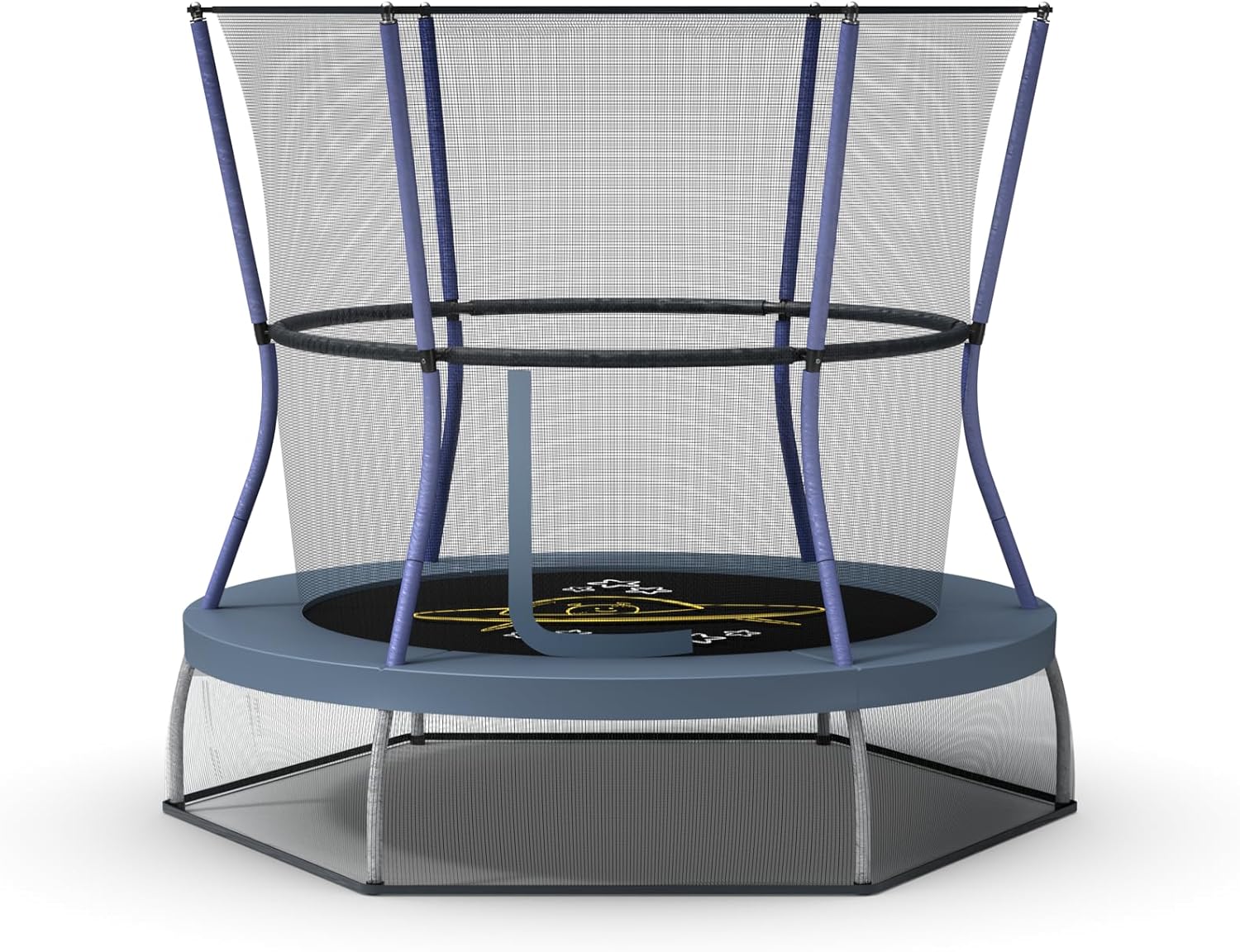
#8. Skywalker 60-inch Mini Trampoline (Spaceship): Best for Kids
PT Score: 6.0 / 10 · Limiting: Mat · Tier: $$
Skywalker is the US trampoline brand most parents already recognise, and the 60-inch Mini with Enclosure has been near the top of every “best trampoline for kids” list for years. Made by Skywalker Holdings out of Brigham City, Utah. The 60-inch round frame is steel with a foam-covered perimeter, the bounce system uses stretch bands instead of metal coil springs (so there’s nothing for little fingers to pinch), the safety net is sewn directly to the jumping mat (no foot-pinch gap at the edge), and there’s a 360-degree padded internal handlebar so a 3-year-old has something to hold while they figure out their balance. The pick below is the Dark Blue/Grey with Spaceship mat at around $125 on Amazon. If your budget caps at $80, the Blue variant with red trim is the same 60-inch base model in a cheaper theme; older Safari Explorer themed mats appear via Home Depot and Skywalker direct. Age range 3-7, max user weight 100 lbs.
Pros
- Stretch bands instead of coil springs (no spring-pinch hazard for toddler hands)
- Safety net sewn directly to the mat surface (no foot-pinch gap at the edge)
- Foam-covered frame perimeter; 360-degree padded internal handlebar
- Themed graphics on the mat are genuinely engaging for the 3-7 age range
- Indoor/outdoor capable; reasonable price point for the build
Cons
- Skywalker keeps a light spec sheet for this model: the mat material, the frame gauge, and the stretch-band count and composition all go unlisted
- 100 lb max user weight is a hard cap; kids will outgrow it around age 7-9
- The bounce is deliberately soft, tuned for toddlers learning to balance, not athletic jumping
- 1-year warranty on bands, mat, and poles; the 3-year frame cover is fine but not best-in-class
Why it earned Best for Kids: For under-7s the safety equation isn’t about adjustable spring tension or jumping surface area; it’s about eliminating the pinch and entrapment hazards a coil spring presents to small fingers, and giving a wobbly toddler something to hold. The 60-inch Skywalker does both. It lands at a mid-tier score rather than a top one, mostly because Skywalker stays quieter about its materials than the build deserves, but for the actual use case (a 3-to-7-year-old learning to bounce in a back garden or a playroom), the Skywalker toddler-mini design hits the right notes. We’ve also covered the SereneLife 36″ Mini and the Wamkos 36″ Dinosaur Mini as alternatives in this segment; both scored lower. For a full breakdown of toddler-and-kids trampolines, see our best trampolines for kids and toddlers guide.
Check Price on Amazon
Read the full review
#9. Fit Bounce Pro II: Best Mini / Adult Fitness Rebounder
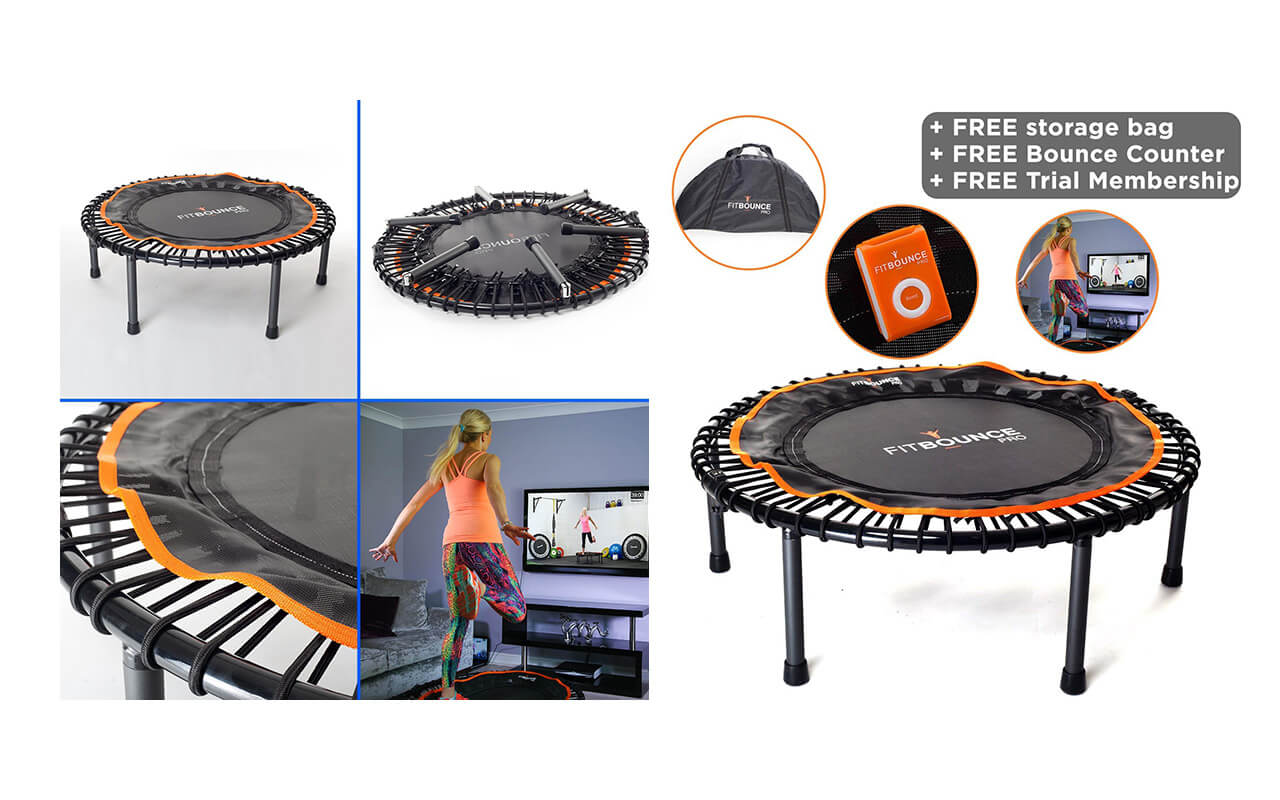
PT Score: 6.0 / 10 · Limiting: Mat · Tier: $$
The Fit Bounce Pro II is the rebounder we’d buy for adult indoor fitness use, and it’s a different category entirely from everything else on this list. Made by Maximus Life Ltd (trading as Rebound Fitness) out of Windsor, Berkshire, UK. The 40-inch folding rebounder uses 30 bungee cords with 60 connection points (patented double-connector system) instead of metal springs, which gives a remarkably quiet bounce and is the single most-cited reason owners pick it for flat or apartment use. Folds in half (“taco fold”) into a zip-up carry bag, arrives fully pre-assembled with the legs clipping into spring-loaded sockets. Max user weight 140 kg / 308 lb. Lifetime frame warranty.
Pros
- Extremely quiet bounce; the #1 reason owners pick it for apartment, flat, or shared-wall use
- Joint-friendly bungee system: praised by arthritis, knee, and back-pain users
- Folds in half into a carry bag; arrives fully pre-assembled, legs clip in with no tools
- Lifetime frame warranty; 30 bungee cords with 60 connection points (patented)
- Includes workout DVD, BounceCounter pedometer, carry bag, and 2 spare bungee cords
Cons
- Bungee cord wear at around 6 months is the most credible recurring owner concern (spare cords included is the brand acknowledging it)
- No tension adjustment (unlike bellicon, which lets you pick cord strength); fixed feel
- Mat surface is small (57 cm / 22 inches across) compared to spring rebounders at similar price
- T-bar stability handle (sold separately) described as “wiggly” by some owners
- The spec sheet is light: no frame gauge, no country of manufacture, and the “tested to UK, EU and USA standards” line never names an actual standard
Why it earned Best Mini Rebounder: For an adult who wants quiet, joint-friendly, low-impact cardio in a living room or a small flat, this is the rebounder we’d buy. It’s roughly a third to a quarter the price of a bellicon and folds for storage, which the bellicon doesn’t. The brand is quiet about the mat material, and the bungee longevity concern is real (plan on replacing cords every 12-18 months for daily users). But for the actual use case, it earns the spot. For more in the rebounder segment, see our best mini trampolines guide.
Check Price on Amazon
Read the full review
Before you buy
Six things to check before you click order. Each one is a one-sentence sanity check; the full breakdown of how to weigh them lives on our trampoline buying guide.
- Frame gauge: thinner steel walls (under 2 mm) fatigue faster; published 2.5-3.0 mm is the gold standard, and brands that won’t tell you the number deserve scepticism.
- Spring count + length: more springs at longer lengths spread load and give deeper, more responsive bounce (industry-typical for a 14ft round is 80-96 springs at 7-8 inches; premium runs 96-124 at 8.5-10 inches).
- Mat material + stitch rows: cross-sewn polypropylene with 10 rows of UV-treated stitching is the durable standard; Permatron is the premium-tier brand name to look for.
- Enclosure pole count + sleeve design: foam-covered poles are baseline, curved poles that lean away from the jumper are better, and a zero-gap or net-sewn-to-mat design eliminates the worst injury zone.
- Warranty BY COMPONENT, not “warranty”: a “10-year warranty” usually means 10 years on the frame and 1-2 years on the mat, pad, and net. Always check the breakdown; the lopsidedness tells you which parts the manufacturer expects to fail.
- In-ground vs above-ground: in-ground gives you the lower fall height and the cleaner garden aesthetic at the cost of digging a proper drainage-managed pit; if you’re not committed to the dig, get above-ground.
For the full breakdown of every spec and how to weigh it, read our Trampoline Buying Guide.
Frequently Asked Questions
What is the best trampoline brand in 2026?
There isn’t one. Different brands lead in different categories, and the right answer depends on what you’re optimising for. For spec disclosure and value, Galactic Xtreme (the only premium rectangle we cover whose frame wall gauge is published). For athletes and mixed-age gymnastics families, ACON’s X line (the only one with three-way adjustable deck height). For in-ground installs, BERG (the only one designing and manufacturing in Europe with the AirFlow vented mat). For springless safety, Springfree (the only vertical manufacturer in the category). For a budget pick from a real brand, JumpYeti. Each one earns its spot on this list for a specific reason; none is the “best brand overall” because the category doesn’t work that way.
Rectangular vs round: which is safer?
Round trampolines pull jumpers toward the centre by virtue of spring tension geometry, which makes them naturally safer for recreational backyard use, especially with younger or less experienced jumpers. Rectangles give a more uniform bounce across the surface and are the geometry serious tumblers and gymnasts need for controlled tricks, but they’re less forgiving when you land off-balance. For a family with under-10s who’ll mostly bounce for fun, round is the safer default. For teenagers who’ll do flips or for an adult athlete, a rectangle is the right tool. Either shape can be made safer with a good enclosure and one-jumper-at-a-time discipline.
What size trampoline do I need?
The rough breakdown: 8-10 ft for small gardens or young children only; 12-14 ft for a standard family with mixed-age kids (this is the most common buy); 15-17 ft for teenagers, serious recreational bouncing, or households with multiple older users who’ll use it independently. In-ground rectangles in the 17 ft class are the gymnastics-tier pick. Always add at least 5 feet of clearance on every side and nothing overhead, so a 14 ft round needs roughly a 24-foot clear square of yard, and a 17 ft rectangle needs about 27 x 20 ft. Measure twice before you commit.
How much should I spend?
Tier expectations. Under $500 buys you a real brand at the budget end (JumpYeti, Zupapa, Skywalker full-size lines) with a 1-3 year warranty and most specs unpublished. $500-$1,500 is the mainstream sweet spot, with 10-year frame warranties, published spring counts, and decent build documentation (Jumpflex HERO, ACON Air, AlleyOOP entry). $1,500-$3,000 buys you genuinely premium kit: lifetime warranties on structural parts, published frame gauges, and the kind of build that justifies a decade of expected use. Above $3,000 is gymnastics-tier and in-ground installations. The Galactic Xtreme 10×17 is the outlier; it gives you $3,000-tier specs at $800-$1,200 because the brand undersells the European premiums on prestige, not on engineering.
In-ground vs above-ground: which is better?
It depends what you’re optimising for. In-ground trampolines like the BERG Champion sit at lawn level, so the fall height is much lower, the trampoline doesn’t dominate the garden, and there’s no waist-high frame to mow around. The trade-offs are real, though. You have to dig and pay for a proper drainage-managed pit (this is a mini-digger job, not a spade-and-Saturday job), the trampoline costs a good deal more (reinforced in-ground frames and vented mats add cost), and the install is essentially permanent. If you’ve already decided you want the ground-level look and the lower fall height and you’re prepared for the excavation, in-ground is worth it. If you mostly want a lot of bounce for your money, above-ground wins on value every time.
Do I need a safety net or enclosure?
For any household with children under about 12, yes, and ideally a no-gap design where the net is sewn to the mat surface or seals to the frame (ACON’s zero-gap, Springfree’s FlexiNet, Skywalker’s net-sewn-to-mat on the toddler line). For older teenagers and adults bouncing carefully, the case is weaker, and plenty of in-ground trampoline owners run without a net because the fall height is low and the lawn is the landing surface. Net heights matter too: industry-typical 6-7 feet is sized for casual bouncing; 9.5-foot nets (Galactic Xtreme) are sized for gymnasts who actually need the headroom for tricks. Don’t skip the net to save $100 if the people using the trampoline are children.
How long should a trampoline last?
Premium frames are designed for 10+ years of normal outdoor use, and the better ones come with warranty cover that reflects that (lifetime frame on Galactic Xtreme and AlleyOOP, 10-13 years on BERG, 10 years on ACON and Springfree). Springs and mats are wear parts: even premium components typically last 5-8 years before you’ll consider replacement, and consumables (pads, nets) wear faster under UV and weather, with 3-5 years being a realistic replacement window. Budget trampolines with 1-2 year warranties usually need full replacement in 3-5 years rather than component replacement. Plan accordingly: a $2,000 premium round amortised over 12 years is roughly the same monthly cost as a $400 budget round replaced every 4 years, but the premium one is a better experience throughout.
What’s the best trampoline for adults?
For backyard fitness or athletic use, heavy-duty rectangles are the answer: the Galactic Xtreme 10×17 (550 lb per-jumper rating, gymnastics-tier 9.5 ft net) or the ACON X 17ft (260-330 lb per jumper depending on deck height, Super X-Frame rigidity, three deck heights to span casual through performance). For indoor low-impact cardio in a living room or small flat, the Fit Bounce Pro II is the rebounder we’d buy (308 lb rating, lifetime frame, folds for storage, quiet enough for shared-wall flats). For safety-focused adult use where joint protection matters more than bounce response, Springfree’s springless design is the pick. Skip toddler-class minis (the Skywalker 60-inch in this list caps at 100 lbs and isn’t designed for adult use).
About this guide
ProTrampolines’ PT Score rates six components and follows the weakest one. Each pick in this guide has been reviewed against manufacturer specifications, retailer listings, warranty terms, owner reports and, where we track it, price history. A component can’t earn top marks if a brand won’t publish the numbers we need to verify it. We don’t accept payment for placement on this list, and the rankings reflect our editorial judgment of which trampolines we’d actually recommend in each category. Our methodology, the per-component breakdown for every score, and the rationale for the weakest-link approach is documented in full at our scoring page. More about who we are and how we work.
This guide will be reviewed and refreshed quarterly. Last updated May 15, 2026.