
When backyard trampolines first became popular, plenty of people assumed they were only for gymnasts and cheerleaders. That was never true. Trampolines are used by all ages, every day, for play and for exercise, and for children the health benefits of regular bouncing are real. The questions below cover what buyers ask us most often, from sizing and weight limits to shapes, safety and how long a trampoline should last.
Do I need any previous gymnastics experience?
No. Anyone can use a trampoline with no prior experience. The only rule is to jump within your ability. Flips and advanced tricks are not beginner moves, so start with controlled, straight bouncing and build up slowly. You do not need to be a gymnast to enjoy a trampoline, and regular bouncing brings real health benefits at every fitness level.
Is there a minimum age for using a trampoline?
For standard outdoor trampolines, age 6 is the usual minimum, and that applies to any trampoline larger than 10 ft. Younger children are better served by trampolines designed specifically for them. Kids’ trampolines are smaller, lower to the ground, and many can be used indoors all year round. A young child can use a larger trampoline safely under close supervision, but don’t expect much height. A small child simply doesn’t put enough weight through the springs to get a big bounce.
What size trampoline should I buy?
This is the most common question we get, and there is no single answer, because the right size depends on who is using it and where it is going. Three things decide it.
- Who will use it. There is no point buying a 14 ft trampoline for one toddler. For small children, an 8 ft or 10 ft trampoline is plenty. A 12 ft trampoline suits children aged 8 and over. Step up to 14 ft or 15 ft for teenagers, or when several children will play together.
- Whether it fits your garden. Measure the space before you buy, and leave clear room on every side. It’s easy to order online and forget how large a trampoline really is once it’s assembled.
- The weight limit. Weight limits matter most on smaller trampolines, up to around 8 ft. Larger trampolines are typically rated for 220 lb or more, and many handle a good deal beyond their stated limit. The next question covers this in detail.
For more help choosing, read our trampoline buying guide.
How much weight can a trampoline hold?
The weight a trampoline can hold is one of the most important safety figures, and the good news is that it’s easy to find. The manufacturer almost always publishes a weight limit. The harder question is whether to trust it. A higher number makes a trampoline more appealing, so some brands quote optimistic figures. Treat the limit with a little healthy scepticism, and look at what actually supports it: the frame, the springs and the mat. The next two questions break this down.
Do all trampolines have the same weight limit?
No. The weight limit varies from model to model and depends on how the trampoline is built, from the frame design and tube gauge to the springs and the mat. Two factors set the rough range: size and shape.
Size. As a rule, the smaller the trampoline, the lower the weight limit. A small children’s trampoline often maxes out around 150 lb, while a large backyard trampoline can handle 400 lb or more. That is enough for two or three adults by rating, although we never recommend more than one person on a trampoline at a time.
Shape. A rectangular trampoline usually holds more weight than a round one of similar size. Rectangular frames spread the load so that only the springs near the jumper are working at any moment, while a round trampoline draws on its springs more evenly with every bounce. Professional gymnasts use rectangular trampolines, so manufacturers build and rate them for heavier, harder use.
Typical weight limits by shape:
- Round, 8 ft: around 175 lb
- Round, 10 ft: roughly 150 to 250 lb
- Round, 12 ft: roughly 200 to 300 lb
- Round, 14 to 16 ft: roughly 250 to 400 lb
- Rectangular, all sizes: roughly 250 to 800 lb
- Oval, 16 ft: roughly 300 to 450 lb
- Octagonal: 250 lb and up
Materials are the other half of the picture. The springs, the frame and the jumping mat all set the ceiling, and if any one of them is low quality the safe weight limit drops with it. That’s why a trampoline from a reputable manufacturer is worth paying for.
How do I work out the jumping area from the diameter?
First, remember that the stated diameter of a trampoline includes the padded edge, so measure the pad and subtract it before you calculate the usable jumping surface.
Round trampolines. The area of a circle is the radius squared, multiplied by pi (3.14159).
- Measure the full diameter in feet.
- Subtract the width of the padding. For a 15 ft trampoline with about 1 ft of total padding, that leaves 14 ft of jumping surface.
- Divide by 2 to get the radius (14 / 2 = 7 ft).
- Square the radius (7 x 7 = 49) and multiply by pi (49 x 3.14159 = 153.9).
- The result, about 153.9 square feet, is the jumping area.
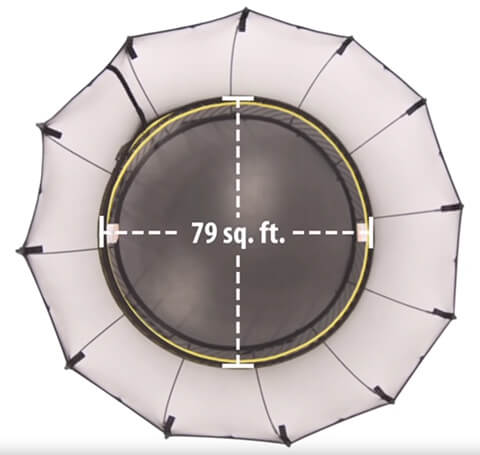
Rectangular trampolines. This one’s simple. Measure the length and the width of the jumping surface and multiply them together to get the area in square feet.
How much does a trampoline weigh?
Trampoline weight depends almost entirely on size. As a rough guide for spring-based models:
- Mini trampolines and rebounders: around 7 to 15 lb
- Small kids’ trampolines, 7 to 8 ft: roughly 50 to 90 lb
- 10 ft round: roughly 100 to 150 lb
- 12 ft round: roughly 150 to 200 lb
- 14 ft round: roughly 200 to 260 lb
- 15 to 16 ft round: roughly 250 to 320 lb
- Large rectangular models: 250 to 400 lb and up
Springless trampolines tend to be heavier than spring models of the same size because of their composite-rod construction. The figure matters for two reasons: a heavier trampoline is more stable in wind, and it is harder to move, so decide where it will live before you assemble it.
What trampoline shapes are available, and when should you use each?
Trampolines come in five main shapes, and each has a purpose. Round is the standard family choice. Rectangular is the performance shape. Oval sits between the two. Square was introduced to bridge the gap between round and rectangular. Octagonal is a less common variation on the round design. There is also a growing category of mini trampolines and rebounders built for indoor fitness rather than backyard play.
Does the shape of a trampoline change the bounce?
Yes, clearly. If the bounce itself is your priority, rectangular, oval and springless trampolines are the ones to consider.
Rectangular trampolines give the highest bounce, but they are not the safest shape, because the jumper decides where they land rather than being guided back toward the centre. Round trampolines are safer for that exact reason: every bounce tends to direct the jumper toward the middle of the mat. The right choice comes down to why you want a trampoline.
- For recreation, a round trampoline is the sensible first choice. It is safer and well suited to casual family bouncing.
- For training, a rectangular trampoline is the better fit. Round trampolines rarely have enough usable area for tricks, while a rectangle gives you the space and the performance.
- For a balance of both, an oval trampoline offers room for tricks while still guiding jumpers back toward the centre, much as a round one does.
What is the best trampoline for recreational use?
For daily recreational use, a 14 ft or 15 ft round trampoline is the most popular choice. If you have the space and want more performance, an Olympic-size 10×17 ft rectangular trampoline, a slightly smaller 9×15 ft rectangle, or an 8×13 ft oval all work well too. With trampolines this large, garden size is the deciding factor, so always leave about 3 ft of clear space on every side. For specific models, see our best trampolines guide and our best value trampolines picks.
Which trampoline is the safest?
Every trampoline we review meets recognised safety guidelines. Genuinely dangerous trampolines are rare, and you won’t find them here. They tend to turn up only as low-cost units in general stores.
That said, some trampolines are safer than others, thanks to a tighter enclosure net, thicker padding and better overall design. Springless trampolines are widely considered the safest type, because they remove the springs entirely, and the springs and frame are where most contact injuries happen. They do carry a higher price tag. For young children, look for purpose-built kids’ trampolines with a low frame height, which shortens the fall if a child does come off. For indoor use with toddlers, choose models with sturdy plastic legs and a gentle, gradual bounce that helps a child keep their balance.
You can compare the safest designs in our springless trampolines section and our best trampolines guide.
How long does a trampoline last?
Lifespan depends mostly on the brand and on care. Upscale brands use higher-grade materials that stand up better to wind, rain and sun, and they reliably outlast bargain products. With regular cleaning, sensible use and a winter cover, even a mid-range trampoline can last well past 7 years on its original parts.
Not every part wears at the same rate. The frame almost always outlasts everything else. The safety pad usually fails first, fraying or tearing at the foam. After that come the mat, then the enclosure netting, and the springs last longest of the wear parts. A mat with more rows of stitching lasts longer. The good news is that most trampolines have reasonably priced spare parts, so a worn mat or pad is a modest repair rather than a reason to replace the whole trampoline.
What is the difference between professional and recreational trampolines?
Professional trampolines are built to be more powerful and more durable than standard backyard models, and they come in one shape only: rectangular. A few things set them apart from home trampolines:
- Despite their size, they are designed to be moved from place to place fairly easily.
- They are used by professionals and semi-professionals for training, and sometimes by keen individuals for serious exercise.
- Their fabrics are specially developed and made sturdier than backyard trampoline materials, while staying light enough to transport.
- The average base size is 14 to 17 ft.
- The springs are considerably longer than on home trampolines, which is what lets them bounce so much higher.
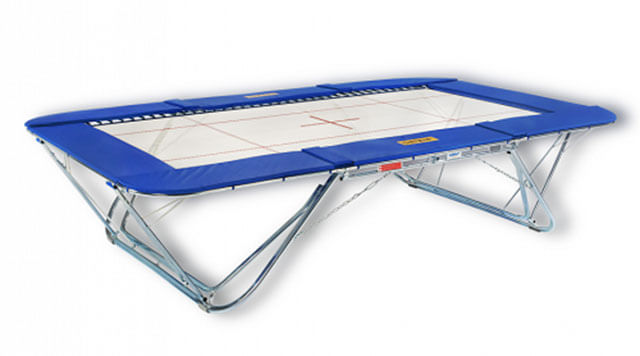
A professional trampoline costs more than a backyard model, and that price is reasonable for the quality competitive athletes rely on. The Eurotramp Ultimate 4×4, shown below, is a true competition-grade trampoline used at the Olympic Games and the World Trampoline Championships.
How do I avoid getting hurt on a trampoline?
There’s no single trick to it, but a handful of habits prevent most injuries:
- Read the trampoline’s user manual. At the very least it covers the basics and some safe starter moves.
- Always use the safety pads and the enclosure net. They are genuine lifesavers.
- Check the mat for cuts or tearing before every session.
- Check that the springs are firmly attached to both the frame and the mat.
- Do not overestimate your ability. Learn to bounce properly before attempting any tricks.
- Never let children use a trampoline unsupervised.
- Allow only one person on the trampoline at a time. Most serious injuries happen with two or more jumpers.
- If other children come over to play, talk through the rules with them first.
Still deciding? Our trampoline buying guide walks through every choice in detail, or the AI Trampoline Finder can match you to a model in two minutes.