Kinetic Trampoline Review (2026)
Find on AmazonProduct prices and availability are accurate as of the date and time indicated and are subject to change. Any price and availability information displayed on Amazon.com at the time of purchase will apply to the purchase of this product.
Limiting: Springs (30/100)
PT Score Breakdown
How we calculate PT Scores →Pros and Cons
Pros
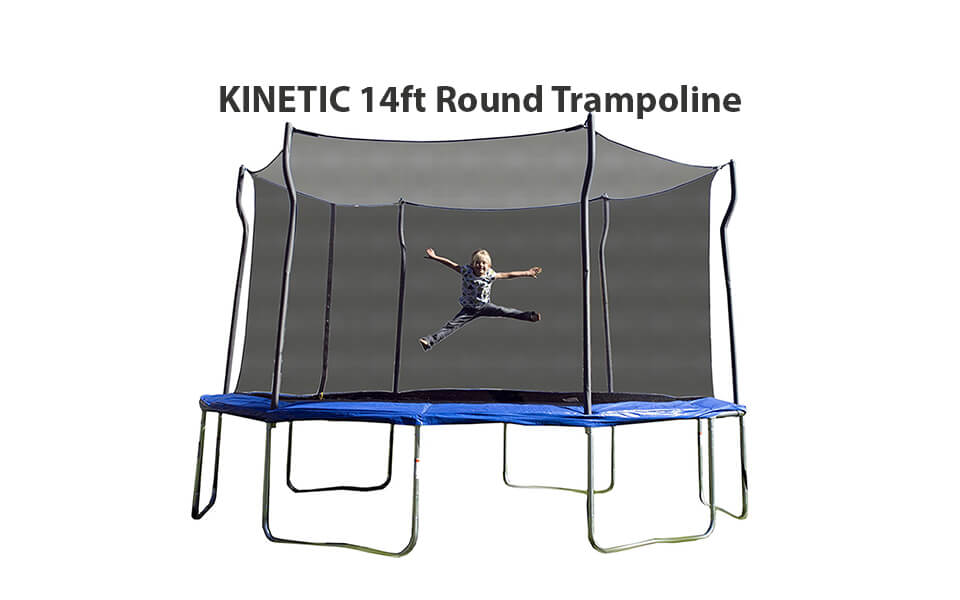
- 6 U-shaped legs for base stability
- Sewn-in net eliminates mat-to-net gap
- ASTM F381 certified
- 15ft model jumps to 108 springs
Cons
- Only 72 springs on 12ft and 14ft models
- 275 lb weight cap
- 90-day warranty on springs, mat, pad, netting
- Sure-Lock pad thins and curls early
- Amazon availability is patchy
Full Review
Quick heads-up before you commit. The Kinetic 12ft and 14ft both ship with only 72 springs, which is light for a mat of that size. Weight capacity is capped at 275 lbs (125 kg). Warranty on springs, mat, padding, and netting is 90 days. The frame itself gets one year. If you’re buying at the budget end and you’re clear-eyed about what those numbers mean, the Kinetic isn’t terrible. If you’re expecting the bounce of a Zupapa or the longevity of a JumpSport, keep reading anyway, because this isn’t that.
What Is the Kinetic Trampoline?
Kinetic is a product line from Propel Trampolines, a US-based family business that’s been pushing out mid-to-budget backyard trampolines since the early 2000s. You’ll find Propel-branded Kinetic models in 12, 14, and 15-foot round versions, all sold through Wayfair, Walmart, Dunhams Sports, and Propel’s own site. Amazon availability is patchy. The main trampoline comes and goes, while accessories like shade covers and ladders stay listed year-round. If you’re specifically shopping Amazon and the main product isn’t there today, that’s the category norm for this line, not a discontinuation.
Worth flagging upfront: the current PT page for this product is thin and the PT Score widget was never populated (every criterion reads zero). We’re rebuilding it from scratch here with verified specs and an honest verdict.
Key Specifications
| Specification | 12ft | 14ft | 15ft |
|---|---|---|---|
| Weight capacity | 275 lbs | 275 lbs | 275 lbs |
| Spring count | 72 | 72 | 108 |
| Frame legs | 6 U-shaped | 6 U-shaped | 6 U-shaped |
| Frame material | Galvanized steel | ||
| Mat | Polypropylene woven mesh, UV-resistant | ||
| Enclosure | Impact-Absorbent, netting sewn to mat, foam-covered poles | ||
| Safety pad | Sure-Lock (blue, foam-filled) | ||
| ASTM F381 | Certified | ||
| Frame warranty | 1 year | ||
| All other parts | 90 days | ||
| Age range | 10+ | ||
| Assembly time | 2-4 hours, 2 people | ||
| Price | Check current price | ||
We couldn’t verify spring length or frame tubing gauge from Propel’s published materials. If you’re comparing on paper, treat those two data points as unknowns until you’ve seen the installation manual.
Build Quality, Frame, Springs, and Mat
The frame is where the Kinetic does a couple of things right. Six U-shaped legs give you better base stability than the five W-leg design you see on a lot of budget 15-footers (looking at you, Pure Fun 9015T). Galvanized steel construction is standard at this tier, and there’s nothing in owner reports to suggest the tubing bends or pits faster than the category average. For a trampoline that’s never pretending to be premium, the skeleton is fine.
The springs are a different conversation. Seventy-two springs on a 14-foot mat works out to roughly one spring every 7.3 inches around the perimeter, which is sparse by any backyard-tier standard. Zupapa puts 96 on the same diameter. JumpSport’s SoftBounce 14ft runs 108 three-inch springs split across inner and outer sets. AlleyOOP uses 96-plus on its 14-footer. The Kinetic’s 72 means you’ll feel a less responsive bounce, and the springs themselves are working harder per jump, so long-term stretch and fatigue become your early failure point. The 15ft model jumping to 108 is a much more sensible density and the main reason we’d recommend that size over the 14 if you’ve got the garden space and the budget’s similar.
Mat material is polypropylene woven mesh with UV resistance, which is the standard spec across the category. Nothing remarkable, nothing obviously cheap. Sun exposure will still eat it over three to five UK summers like any other budget mat.
Safety
The enclosure is the part Propel actively markets. They call it the “Impact-Absorbent Enclosure System” and the key design choice is that the net is sewn directly to the jumping mat, so there’s no gap between mat and net where a child’s foot can slip through and catch a spring. That’s genuinely useful, and it’s the same pattern you see on Skywalker’s higher-tier models. Poles are foam-covered, blue safety pad runs the full perimeter over the springs, and the whole thing carries ASTM F381 certification (the consumer trampoline standard for components, assembly, use, and labelling).
Where the Kinetic gets average grades is the pad. The Sure-Lock pad is functional but on the thinner side compared to what Acon, JumpSport, or Zupapa ship. Owner reports mention the pad showing fade and starting to curl at the edges well inside the first year, which matches a pattern we see across Propel-tier products and is a big reason the 90-day warranty on pad and netting feels stingy. You’re buying a 1-year commitment from Propel on the frame, and much less on everything you’ll actually replace first.
Assembly
Propel’s manual quotes a 2-person, 2-to-4-hour assembly window. Owner reports lean toward the longer end of that, especially for the 14 and 15-foot versions. Missing hardware shows up in roughly one in every ten to twenty reviews across Wayfair and Walmart listings, which is par for the course at the budget tier but still worth budgeting a day for. The instructions are adequate rather than good. If you’ve put together any similar trampoline before, you won’t struggle. If this is your first one, set aside an afternoon and make sure you’ve got a second pair of hands for the enclosure poles.
How It Compares
| Model | Weight cap | Springs (14ft) | Warranty (frame) | Tier | Price |
|---|---|---|---|---|---|
| Kinetic 14ft (Propel) | 275 lbs | 72 | 1 year | Budget | Check current price |
| Zupapa 14ft | 425 lbs | 96 | 10 years | Mid-range | Check current price |
| JumpSport 14ft SoftBounce | 250 lbs | 108 (3in) | 10 years | Premium | Check current price |
| AlleyOOP 14ft PowerBounce | 200 lbs | 96 | 10 years | Premium | Check current price |
The Kinetic comes out on top on exactly one metric: static weight capacity versus the JumpSport and AlleyOOP. Everywhere else, it’s giving up ground. Zupapa’s 425 lb cap is nearly 55% higher. Every competitor here ships with more springs. Every competitor here gives you at least 10 times the frame warranty coverage. If you can stretch the budget to any of the three, you should.
Who This Is For
- Families on a tight budget who want a round enclosed trampoline with ASTM certification
- Households with one or two children under 10 and no plans to have multiple kids bouncing simultaneously
- Buyers who’ve accepted that they’ll likely replace the pad and possibly the netting within two years
- Anyone who values a sewn-to-mat enclosure over the gap-style design on cheaper rivals
Who This Is NOT For
- Adults planning regular use. The 275 lb cap and 72 springs won’t hold up
- Families expecting the bounce quality of a JumpSport, Acon, or Zupapa
- Anyone who treats warranty length as a proxy for durability (you’re getting 90 days on springs)
- Buyers in coastal or high-UV locations wanting a trampoline to last 5+ summers without part swaps
- Households with two or more teens
Our Verdict
The Propel Kinetic does enough right to avoid being called bad. The 6 U-leg frame is solid, the sewn enclosure is a legitimate safety feature, and ASTM certification is real. But the spring density on the 12 and 14-foot models is thin, the warranty terms are below the category baseline, and owner reports show the pad wearing faster than it should. At this tier, you’re paying for the frame and the certification. Everything else is on borrowed time.
If the Kinetic 15ft is what’s in front of you and the price is right, the 108-spring count makes that size a reasonable budget buy. For the 12 and 14-footers, we’d nudge you toward a Zupapa or a JumpSport if you can stretch. Check our buying guide and the round trampolines category for current alternatives.
Frequently Asked Questions
Q: Who makes the Kinetic trampoline?
A: Kinetic is a product line from Propel Trampolines, a US-based family company. The name shows up on retailer listings as both “Propel Kinetic” and just “Kinetic,” but it’s the same product.
Q: Is the Kinetic trampoline ASTM certified?
A: Yes. All Kinetic models carry ASTM F381 certification, which is the US consumer trampoline standard for components, assembly, use, and labelling. Check the PT safety guide for how ASTM compares against European and TUV marks.
Q: What’s the weight limit on the Kinetic trampoline?
A: 275 lbs (roughly 125 kg) across all three sizes (12, 14, and 15 feet). That’s the ceiling, not a recommendation, so for families with teens or adults we’d treat it as a hard cap rather than a target.
Q: How long does assembly take?
A: Propel’s manual says 2 people, 2 to 4 hours. Real-world reports lean toward the longer end of that range, especially for the 14 and 15-foot versions. Plan a half day and have a second person on hand for the enclosure poles.
Q: How does the Kinetic compare to Skywalker?
A: The Kinetic has a slightly better weight cap than Skywalker’s 15-footer (275 lbs vs 250 lbs) but ships with fewer springs. Skywalker typically gives you a 3-year frame warranty versus Kinetic’s 1 year, and the two brands sit at similar price points, so Skywalker’s the safer buy for most families.
Q: Is the Kinetic warranty any good?
A: Not really. You get 1 year on the frame and springs, and 90 days on the mat, pad, netting, and poles. That’s below what Zupapa, JumpSport, AlleyOOP, and even Skywalker offer. If the pad or net fails in month four, you’re buying replacements.