AlleyOOP PowerBounce 10×17 Rectangle Trampoline Review
Check Price on AmazonLimiting: Value (60/100)
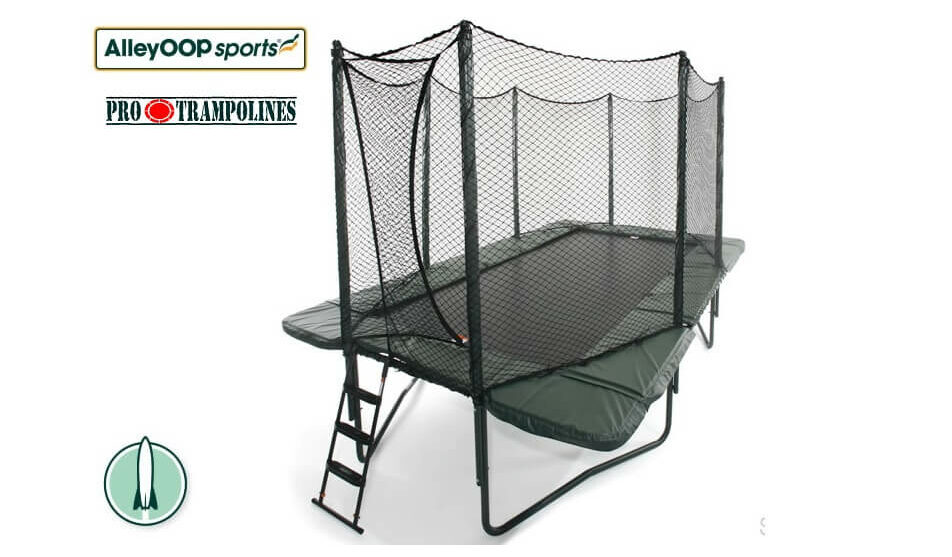
PT Score Breakdown
How we calculate PT Scores →Pros and Cons
Pros
- 164 dual-layer springs (92 primary 9.25" + 72 PowerSprings) with 3-setting adjustability
- 350 lb single-user weight capacity, among the highest in residential rectangles
- Lifetime frame + pole warranty, 5-year springs
- 2" frame tube with 2.5mm walls, pre-galvanised + powder-coated
- 7-foot enclosure height, overlapping patented door
- Owners report 8+ years with minimal repairs
Cons
- $3, 399-$3, 899, premium pricing, well above ACON Air 16 ($2, 000-$2, 500)
- Frame pad only has a 2-year warranty (the documented weak link)
- Needs a minimum ~20x27ft yard footprint with safety clearance
- Assembly takes ~4 hours with 2 people; enclosure instructions are unclear
- No mass-market retail, dealer-only pricing
Full Review
The AlleyOOP PowerBounce 10×17 is a premium rectangular trampoline built by JumpSport, Inc. out of San Jose, California. It sits firmly at the top of the residential market, where you could buy several budget trampolines for the same outlay. The obvious question is whether this thing justifies the cost, or whether JumpSport is just charging a premium for the name.
After reviewing the specs, owner feedback spanning 8+ years, and comparing it against the two closest competitors (the ACON Air 16 Sport HD and Springfree Rectangle), we think the PowerBounce 10×17 is the strongest residential rectangular trampoline you can buy today. But “strongest” and “best value” aren’t the same thing, and there are real weak points you should know about before spending this kind of money.
Key Specifications
| Specification | Detail |
|---|---|
| Frame size | 10 ft x 17 ft |
| Frame tube diameter | 2 inches |
| Frame wall thickness | 2.5 mm |
| Frame material | Pre-galvanised steel, powder coated (forest green) |
| Frame height (ground to mat) | 40 inches |
| Total springs | 164 (92 primary + 72 PowerSprings) |
| Spring length | 9.25 inches |
| PowerBounce assemblies | 56 adjustable TripleStage-DualSpring assemblies |
| Power settings | 3 (top / middle / bottom stage on PowerArm) |
| Max user weight | 350 lbs |
| Total product weight | 653 lbs |
| Enclosure height | 7 ft above mat |
| Enclosure poles | 8, heavy-gauge galvanised + powder coated |
| Enclosure door | Overlapping entry (no zipper, patented design) |
| Frame pad width | 14 inches |
| Frame pad thickness | 1 inch closed-cell foam |
| Frame pad cover | 21 oz reinforced PVC, UV/water resistant |
| Warranty (frame + poles) | Lifetime |
| Warranty (springs) | 5 years |
| Warranty (mat + enclosure) | 5 years (manufacturer) / 10 years (some retailers)* |
| Warranty (frame pad) | 2 years |
| Price range | Check current price |
*The mat/enclosure warranty shows as 5 years on JumpSport’s site and 10 years on some Amazon and dealer listings. We’d recommend confirming with your specific retailer before purchasing.
A note on the jumping surface: several sources cite 113 sq ft, but actual mat dimensions (as opposed to overall frame dimensions) aren’t published by JumpSport. The usable bounce area will be smaller than the 10×17 frame footprint once you account for the spring attachment zone.
How PowerBounce Works (And Why It Matters)
This is the section that matters most, because the PowerBounce system is the entire reason this trampoline costs more than the VariableBounce model below it in the AlleyOOP lineup.
Most trampolines use a single layer of springs connecting the mat to the frame. You get one bounce feel, and that’s it. The PowerBounce does something different.
Each of the 56 PowerBounce assemblies contains two springs mounted on a lever fitting called the PowerArm:
- The upper (primary) spring connects the PowerArm to the V-ring on the mat
- The lower PowerSpring attaches to one of three positions on the PowerArm
That lower PowerSpring is the key. As you jump, the primary springs stretch first. Then the PowerSprings engage through the lever action of the PowerArm, amplifying the bounce force. The result is a staged bounce: soft on landing, powerful on the rebound.
The three positions change the feel:
1. Bottom stage = maximum shock absorption and the strongest staging effect. Softest landing, most bounce. Best for lighter jumpers, younger kids, or anyone prioritising joint protection. 2. Middle stage = moderate firmness. The default starting point for most families. 3. Top stage = firmest response. Higher performance feel for heavier jumpers and athletes who want maximum rebound height.
No other residential trampoline on the market offers adjustable spring settings. That’s not marketing fluff. JumpSport holds 24 granted patents as of 2014, and they’ve won seven-figure patent infringement settlements against Hedstrom and JumpKing to protect this technology.
For families, the tunability solves a real problem. A 70 lb child and a 200 lb adult can use the same trampoline with the springs adjusted to suit each. On a fixed-spring trampoline, you pick one tension level and everyone adapts to it.
PowerBounce vs VariableBounce: Same Brand, Less Money
If you’re shopping the AlleyOOP 10×17 range, you’ll hit this decision quickly. The VariableBounce uses staged springs (alternating long and short V-rings) but without the dual-layer PowerBounce mechanism. It sits one tier below the PowerBounce in the AlleyOOP lineup, with a noticeable price gap.
What you give up:
- No PowerArm lever system, so no amplified bounce staging
- No adjustable settings (the spring response is fixed)
- Slightly less bounce height and less cushioned landing, based on owner comparisons
What you keep:
- Same 10×17 frame, same steel gauge, same powder coat
- Same enclosure system and overlapping door
- Same warranty structure
- Still a significantly better rectangular trampoline than most of the market
The VariableBounce is a solid trampoline. If your budget caps out lower and you don’t need the tunability, it’s a smart buy. But if you’re already spending in the premium range, the extra cost for PowerBounce is where the real engineering lives. People who’ve used both consistently say the PowerBounce model feels like a different class of trampoline.
Who This Is For
Competitive gymnasts and G-Tramp athletes. The PowerBounce 10×17 is widely considered the top choice for backyard gymnastics training. The rectangular shape gives a consistent bounce across the entire mat (unlike round trampolines, which direct you toward the centre), and the 10×17 surface provides enough room for tumbling sequences. The 350 lb capacity and adjustable firmness mean it can handle aggressive use without the mat bottoming out.
Families who want one trampoline to last a decade. Long-term users regularly cite 8+ year lifespans with minimal repairs beyond pad replacement. If you’re tired of replacing cheap trampolines every three years, the upfront cost starts to make more sense over time.
Households with mixed ages and weights. The three power settings mean a child, a teenager, and an adult can all get a bounce tailored to their size. This is genuinely unique in the residential trampoline market.
Buyers who view this as exercise equipment, not a toy. At this price tier, this isn’t a casual backyard purchase. The people who are happiest with it tend to be those who treat it as a long-term fitness investment rather than a seasonal plaything.
How It Compares
| Factor | AlleyOOP PowerBounce 10×17 | ACON Air 16 Sport HD | Springfree Rectangle |
|---|---|---|---|
| Frame size | 10 ft x 17 ft | 9 ft x 16 ft | 8×11 ft or 8×13 ft |
| Price | Check current price | Check current price | Check current price |
| Spring system | 164 dual-layer, adjustable (3 settings) | 140 single-layer, fixed | Fiberglass rods (no metal springs) |
| Customisable bounce | Yes (3 settings) | No | No |
| Weight capacity | 350 lbs | Not confirmed | 220-330 lbs (varies by size) |
| Frame warranty | Lifetime | Strong (verify exact terms) | 10 years |
| Best for | Athletes, gymnasts, families wanting max bounce | Best value rectangle | Safety-first families |
The ACON Air 16 Sport HD is the value play. At roughly half the price, it’s a well-built rectangle with a strong reputation among gymnasts. Its 140 single-layer springs deliver good bounce, but there’s no adjustability. For most families who want a quality rectangle without the premium price tag, the ACON is hard to beat. Where it falls short is the bounce customisation and the overall build quality difference you can feel when you compare them side by side.
Springfree takes a completely different approach. No metal springs at all. Fiberglass rods mounted below the mat create the bounce, and the frame sits outside the jumping surface. It’s the safest design on the market, and it’s a good trampoline, but owners consistently describe the bounce as softer and less responsive than spring-based models. If your primary concern is safety and you’re willing to trade bounce performance for it, Springfree is the right choice. If bounce quality and athleticism come first, the AlleyOOP wins.
For more on rectangular options, see our rectangular trampolines category or check the trampoline buying guide for help narrowing things down.
The Price: Is It Worth It?
There’s no point dancing around it. The PowerBounce 10×17 sits at the top of the residential rectangular trampoline market, and the price reflects that.
But consider the longevity. Buyers regularly report 8-10+ years of use, and JumpSport’s lifetime frame warranty backs that up. Spread over a decade of near-daily use, the cost-per-year drops fast.
Compare it to a family gym membership or a gymnastics programme for one child, both of which add up to substantial sums over the same period. A backyard trampoline doesn’t replace structured coaching, but for daily practice and general fitness, it pays for itself in convenience alone.
Or look at it from the other direction. A budget trampoline that lasts three years (generous for most budget models) needs replacing twice over the same 8-year period. You spend more in total on inferior equipment, plus the assembly and disposal hassle each time. The PowerBounce costs more upfront, but less per year of actual use, and the experience isn’t comparable.
The honest answer is that most families don’t need a premium trampoline. If you want a good rectangle for recreational use, the ACON Air 16 at roughly half the price will serve you well. The PowerBounce 10×17 is for buyers who’ve decided they want the best, who’ll use it hard and often, and who’d rather pay once than replace twice.
Space Planning: You Need More Room Than You Think
A 10×17 ft trampoline needs 5 ft of clearance on every side. That means your yard needs a minimum clear area of 20 ft wide by 27 ft long, with nothing overhead (branches, power lines, washing lines).
This thing weighs 653 lbs assembled. Once it’s in place, you’re not moving it casually. Pick your spot before you start building. Level ground matters for safety and frame longevity, and several buyers recommend anchoring it against wind. Wind vulnerability is a recurring complaint in exposed yards, with reports of legs rusting and frames shifting in storms.
Assembly: Budget Half a Day
The old version of our page said assembly takes “4 hours and several drinks.” That’s about right based on buyer feedback, but here’s more detail.
Plan on 4-6 hours with two adults. The frame and mat go together without much trouble, and most people find that part manageable. The enclosure is where things slow down. Multiple reviews specifically call out the enclosure instructions as confusing, with some describing the process of threading poles and attaching the net as the most frustrating part of the build.
A few practical tips from buyer reports:
- Two adults minimum. The frame components are heavy, and you’ll need someone holding parts while the other person bolts them together.
- Pre-sort all hardware before you start. Skipping this step is a regret you’ll hear about repeatedly in reviews.
- Give yourself a full afternoon. Rushing leads to mistakes, and at 653 lbs you don’t want to disassemble and redo anything.
Once it’s built, it’s built. The finished product feels rock solid.
Safety Enclosure
The PowerBounce 10×17 uses JumpSport’s Triple-Fail-Safe enclosure system with eight heavy-gauge poles. The standout feature is the overlapping entry door. There’s no zipper. Instead, two panels of netting overlap, creating a passage you push through to enter and exit. The panels close behind you automatically.
Parents tend to love it. No forgotten zippers, no doors accidentally left open, no kids falling out of a gap. The downside is that taller adults sometimes find the entry awkward. You duck and push through rather than unzipping and stepping in. It’s a safety-first design, and the trade-off is convenience.
The enclosure poles are galvanised and powder coated to match the frame. At 7 ft above mat height, there’s plenty of vertical clearance for big bounce heights without hitting the net during normal use.
The Weak Links
Frame pad durability. This is the most predictable maintenance item. The 14-inch, 21 oz PVC pad carries only a 2-year warranty, and buyer reviews confirm that’s roughly how long it lasts before UV and weather start breaking it down. Expect to replace the pad at some point. The rest of the trampoline will outlast it by years.
Shipping and packaging. Some buyers report receiving damaged or missing parts on delivery. JumpSport’s customer service gets consistently strong reviews for resolving these issues, but it’s frustrating when a premium product arrives with problems out of the box.
Enclosure instructions. As mentioned in the assembly section, these are widely cited as the weakest part of the build process.
Wind exposure. In yards without wind protection, buyers report leg rust and frame movement. Anchor kits are available and a smart investment if you’re in an exposed location.
Strap warranty. One buyer reported being told that straps carry only a 6-month warranty, separate from the enclosure warranty. Confirm with your retailer before purchasing.
Pros and Cons
Pros:
- The only residential trampoline with adjustable bounce settings (3 stages)
- 164 dual-layer springs produce exceptional bounce quality, described by owners as “incredible” and “monster bounce”
- 350 lb weight capacity handles athletes and larger adults
- Lifetime frame warranty from a company that’s been around since 1997 and has won patent lawsuits to protect its designs
- 10×17 ft rectangular surface with consistent bounce across the full mat
- Overlapping door eliminates accidental enclosure openings
- Strong customer service reputation from JumpSport
- Multiple owners report 8+ years of use with minimal repairs
Cons:
- Premium pricing puts it out of reach for many families
- Frame pad deteriorates within ~2 years (shortest warranty component)
- 653 lbs and requires a 20×27 ft yard footprint
- Enclosure assembly instructions are confusing
- Shipping issues (damaged/missing parts) reported by some buyers
- Vulnerable to wind damage without anchoring
- Overlapping door can be awkward for adult entry
Our Verdict
The AlleyOOP PowerBounce 10×17 is the best-performing residential rectangular trampoline we’ve reviewed. The dual-spring PowerBounce system delivers a bounce that owners describe as “incredible” and “monster,” and the three adjustable settings make it versatile across different body weights and skill levels. JumpSport’s construction quality, lifetime frame warranty, and 8+ year track record from real buyers back up the premium positioning.
It’s not the right trampoline for everyone.
If you want a good rectangular trampoline for weekend family use and you’re watching the budget, the ACON Air 16 Sport HD is a better fit at roughly half the price. If safety is your number one priority above all else, Springfree’s springless design is purpose-built for that.
But if you’re a gymnast training at home, a family that plans to use this thing hard for the next decade, or someone who simply refuses to compromise on bounce quality, the PowerBounce 10×17 is the trampoline you’ll keep coming back to. At spread over an 8-year lifespan, the sticker shock fades once you’re actually jumping on it.
Read more about AlleyOOP’s full lineup on our AlleyOOP brand page, or compare the round models: the AlleyOOP DoubleBounce 14ft and the AlleyOOP PowerBounce 14ft round.
Frequently Asked Questions
What is PowerBounce technology on AlleyOOP trampolines?
PowerBounce is JumpSport’s patented dual-spring system. Each of the 56 PowerBounce assemblies contains two springs mounted on a lever fitting called the PowerArm. As you jump, the primary springs engage first, then the secondary PowerSprings amplify the bounce through the lever action. You can adjust the PowerSprings to one of three stages (bottom, middle, top) to change the bounce firmness. Bottom gives the softest landing and most bounce; top gives the firmest, highest-performance response. No other residential trampoline offers anything equivalent.
How does the PowerBounce compare to the VariableBounce?
The VariableBounce uses staged springs (alternating long and short V-rings) for a progressive bounce feel, but it’s a single-layer system with no adjustability. The PowerBounce adds a second spring layer plus the PowerArm lever, creating a stronger staged effect and three selectable firmness settings. The VariableBounce sits one tier below in the lineup and shares the same frame and enclosure. If you don’t need adjustable bounce and want to save money, the VariableBounce is a solid choice. If you want the best bounce JumpSport makes, it’s the PowerBounce.
Is the AlleyOOP 10×17 worth the price?
That depends on how you’ll use it and how long you’ll keep it. Buyers who’ve had it 8+ years call it one of the best purchases they’ve made. Spread over a decade of near-daily use, it costs less per year than most gym memberships and gets used more often. For casual weekend bouncing, a cheaper rectangle like the ACON Air 16 makes more sense. The PowerBounce earns its price for families who’ll use it daily, athletes who need adjustable performance, and people who prefer buying once over replacing a cheaper model every few years.
How long does assembly take?
Budget 4-6 hours with two adults. The frame and mat go together without much fuss. The enclosure is where people slow down, with instructions that multiple buyers describe as unclear. Pre-sorting all hardware before you start saves a lot of headaches. Once it’s together, the finished product feels rock solid.
What’s the weight limit?
350 lbs. That’s higher than most residential trampolines, including the Springfree Rectangle (220-330 lbs depending on size). It handles adult athletes as comfortably as it handles children.
Is the AlleyOOP good for gymnastics?
The 10×17 PowerBounce is widely regarded as the top choice for backyard gymnastics. The rectangular shape gives consistent bounce across the full surface (round trampolines push you toward the centre), the large mat accommodates tumbling sequences, and the adjustable firmness lets you dial in the response for different skills. It’s popular in the G-Tramp community, where athletes use residential trampolines for garden-based training.
Does JumpSport still make the PowerBounce?
Yes. JumpSport, Inc. is the parent company, and AlleyOOP is their outdoor trampoline brand. They’ve been in business since 1997, hold 24 granted patents as of 2014, and sell the PowerBounce through their website, Amazon, and authorized dealers. The company isn’t going anywhere.
How much yard space do I need?
A 10×17 ft trampoline needs 5 ft of safety clearance on all sides. That’s a minimum of 20 ft wide by 27 ft long with nothing overhead. At 653 lbs assembled, pick your location before you start building. You won’t be repositioning it after.
Price History
Get notified when the price drops
Set a target price and we'll email you when it's reached.