Jumpflex HERO Trampoline Review (2026): 12ft, 14ft & 15ft
Price checked 24 Oct 2026, 15:15 UTC
Check price on AmazonProduct prices and availability are accurate as of the date and time indicated and are subject to change. Any price and availability information displayed on Amazon.com at the time of purchase will apply to the purchase of this product.
Limiting: Frame (66/100)

PT Score Breakdown
How we calculate PT Scores →Pros and Cons
Pros
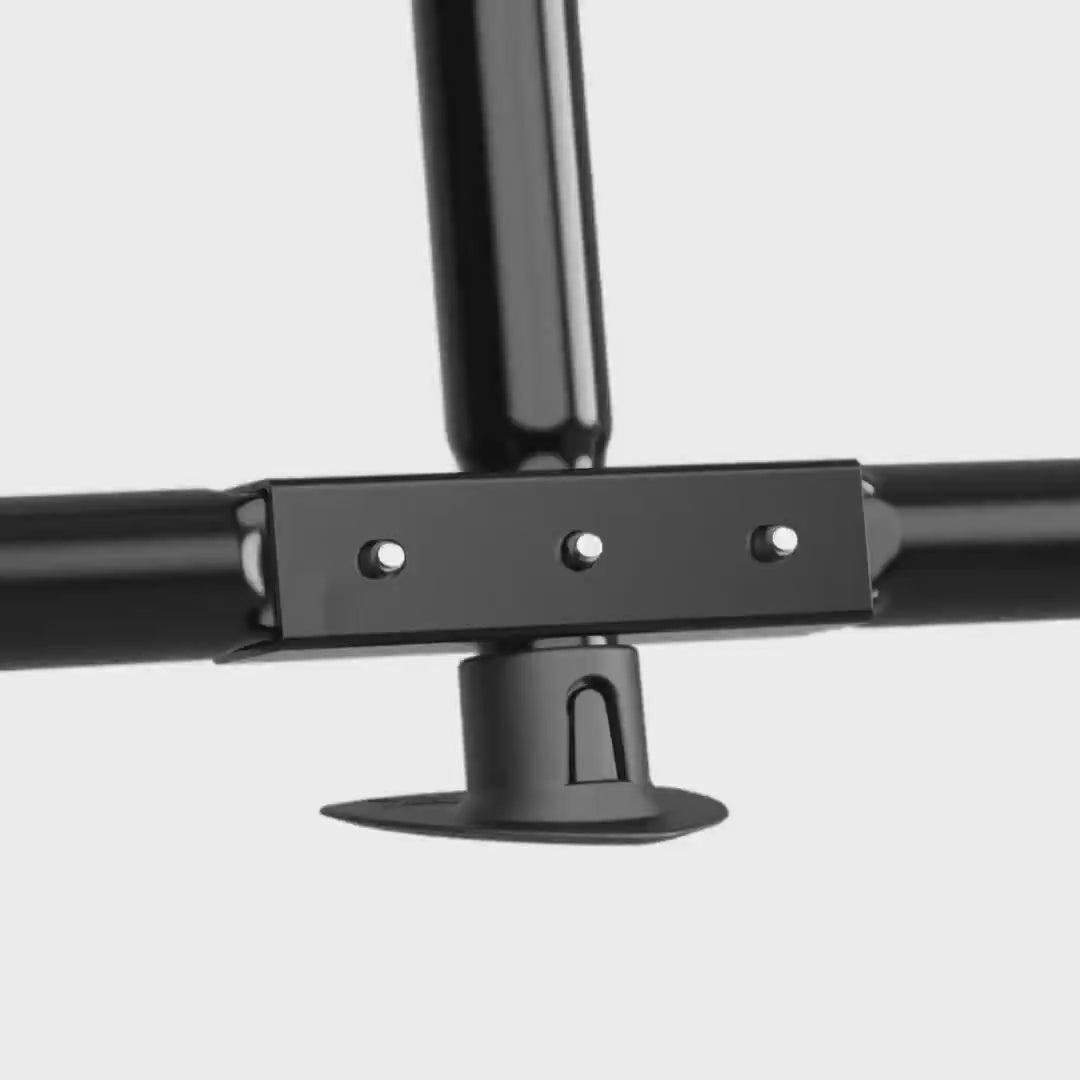
- FrameFusion: no-bolt, no-weld snap-together T-joint frame, won an Australian Good Design Award (Jumpflex calls it patented; we could not surface a filing in USPTO/NZ/AU databases, so treat the patent language as a brand claim with the Good Design Award as the verified credential); the headline reason a 14 ft can be built tool-free in about 20 minutes with two people
- DualRing layout: upper 42 mm / 1.7 in plus lower 38 mm / 1.5 in high-tensile steel rings, galvanised plus a UV-resistant powder coat
- Net + ladder included in the box (not add-on costs of $100 to $200 like some competitors); curved foam-sleeved poles that lean away from the jumper, SafeSeal self-closing zip entrance
- 350 lb per-jumper limit is generous for a 14 ft round; 550 lb total structural rating on the frame (two distinct numbers, do not conflate)
- 10-year frame warranty backed by Jumpflex; ASTM and CE certified
- New Zealand design pedigree (Hamilton, NZ), good design awards, and a brand actively expanding into the US market
- Mid-budget pricing (around $900 on sale, $1,199 list) that undercuts the AlleyOOP-tier premium while feeling a step up from the Zupapa-tier value
Cons
- Jumpflex does not publish the frame steel-tube wall gauge; the verified mitigants are the published ring ODs, the Australian Good Design Award, and the 10-year frame warranty, but a spec-driven buyer is trusting those rather than a gauge number
- Snap-together no-bolt frame is unconventional in this segment: ACON, BERG, and AlleyOOP all use bolted-and-welded construction with decades of field data; Jumpflex only entered the US market in 2024-2025, so long-term joint integrity is the open question
- Jumpflex publishes a thinner spec sheet than ACON or BERG: the mat fibre, the stitch-row count, and the enclosure pole count are not stated, and the net and pad warranty terms are not broken out from the 5-year springs and mat cover
- 88 springs at about 7.1 in is mid-tier rebound for a 14 ft (ACON Air 14 ft runs 96 at 8.5 in, AlleyOOP 14 ft PowerBounce runs 96 dual-layer with adjustable firmness); fine for family bouncing, less so for performance use
- Specific ASTM standard number is not cited; designed in New Zealand but manufactured in China, so not "NZ-made" or "European-made" if that matters
- At the $1,199 list price the value case thins out and overlaps with ACON-tier kit that out-documents it; watch for the sale
Full Review
PT Score: 6.6 / 10
Jumpflex is the trampoline brand most American buyers haven’t heard of yet, and the HERO is the product that’s about to change that. It’s a New Zealand company, founded in 2009 and run out of Hamilton, that designs and engineers its trampolines at home and manufactures them in China under its own quality oversight. The HERO line is its main premium tier, and it pushed into the US Amazon market in 2024 and 2025, which is why it keeps turning up on “best 14ft trampoline” roundups now and didn’t a couple of years ago. The hook, the one thing everyone writes about, is the frame: a patented, no-bolt, no-weld, snap-together system Jumpflex calls FrameFusion. It’s the reason a 14 footer can be built in about 20 minutes with no tools at all.
This is our first Jumpflex coverage on the site, so we’ll spend a bit more time than usual on what the brand is and isn’t. After working through the published specs, the gaps in those specs, the warranty structure, and stacking the HERO against the three other 14ft rounds we cover, we land at a 6.6 out of 10 under our weakest-component scoring. The frame is the limiting factor. Not because we think it’s flimsy, but because Jumpflex doesn’t publish the steel-tube wall gauge, the snap-together design is unconventional in this segment, and the brand simply hasn’t been in the US long enough to point at a decade of field reviews the way ACON or BERG can. A buyer cross-shopping the ACON Air 14ft review, which publishes more of its frame numbers, deserves to know that gap is there.
Key Specifications
| Specification | Detail |
|---|---|
| Shape | Round |
| Nominal size | 14 ft |
| Overall diameter | 15.1 ft at the widest point (“14ft” is the nominal size, not the widest point) |
| Jumping mat diameter | 12.1 ft (3.69 m) |
| Frame technology | FrameFusion: patented no-bolt, no-weld snap-together T-joint connectors |
| Frame configuration | DualRing: upper ring 42 mm / 1.7 in OD plus lower ring 38 mm / 1.5 in OD, high-tensile steel, powder coated |
| Frame tube wall gauge | Not published by Jumpflex |
| Frame finish | Galvanized inside and out, plus a UV-resistant black powder coat on visible sections |
| Springs | 88 high-tensile extension springs, about 7.1 in |
| Jumping mat | Polypropylene (inferred; Jumpflex doesn’t state the material or the stitch-row count) |
| Safety pad | Included; thickness and material not published |
| Net | 100% high-strength polyester, “TightWeave”, UV additive; “SafeSeal” self-closing zip entrance; curved foam-sleeved poles that lean away from the jumper; pole count not published |
| Net included | Yes, in the box (not a separate purchase) |
| Ladder included | Yes, in the box |
| Max individual user weight | 350 lbs (per-jumper limit) |
| Total structural weight rating | 550 lbs (frame load capacity, NOT a per-person figure; the per-jumper limit is 350 lbs) |
| Floor-to-mat height | 2.9 ft |
| Net height | 6 ft |
| Total height (mat + net) | 8.9 ft |
| Recommended clearance | 3.3 ft around the trampoline |
| Assembly | Tool-free; about 20 minutes with two people (manufacturer claim) |
| Certification | ASTM-certified and CE-certified (specific standard numbers not published) |
| Warranty: frame | 10 years |
| Warranty: mat | 5 years (per jumpflex.com.au) |
| Warranty: springs | 5 years (per jumpflex.com.au) |
| Warranty: net / pad | Covered under warranty; specific year counts not separately broken out |
| Age range | Not published |
| Shipping | 3 boxes, roughly 252 lbs total ship weight |
| Country | Designed in New Zealand; manufactured in China |
| In the box | DualRing frame with FrameFusion connectors, mat, 88 springs, safety pad, full net enclosure (poles + netting), ladder, assembly manual |
| Price | Check current price |
A note on that price line. We weren’t able to confirm a live Amazon figure for the 14ft HERO, but the picture is consistent across Jumpflex’s own US store and a couple of third-party retailers: around $900 on sale, $1,199 at list. So put it in the upper-mid tier. It undercuts the AlleyOOP-tier premium and sits above the Zupapa-tier value brackets. We’re not going to quote a number that’ll be stale next week, but the practical takeaway is that this is a mid-budget trampoline that’s trying to feel a step up, and at the sale price it mostly pulls that off. We’ll come back to the value math at the end.
Jumpflex HERO Sizes: 12ft, 14ft and 15ft
The HERO comes in three round sizes, and they’re the same trampoline in every way that matters except footprint, spring count, and price. Same FrameFusion no-bolt frame, same DualRing tube diameters (42 mm and 38 mm), same six-layer rust treatment, same net and ladder in the box, same 10-year frame warranty, and the same 550 lb structural rating across all three. What changes is how much yard you need and how much jumping surface you get.
| Size | Overall footprint | Springs | Approx price (Jumpflex direct) | Best for |
|---|---|---|---|---|
| 12ft | 145.6 in / ~12.1 ft | 80 | ~$799 | Smaller yards, younger kids, a tighter budget |
| 14ft (reviewed here) | 169.1 in / ~14.1 ft | 88 | ~$874 | The middle pick: room for a mixed-age family without a huge lawn |
| 15ft | 181.1 in / ~15.1 ft | 96 | ~$949 | The most surface and highest spring count, if you have the space |
The spring count climbs with size (80, 88, 96), but a higher count on a bigger frame keeps the bounce feel consistent across sizes rather than making the 15ft springier; the springs are about 7.1 inches on all three. The footprint isn’t the whole story either: Jumpflex asks for about 3.3 ft of clearance around the trampoline, so a 15ft HERO really wants a clear circle closer to 22 ft across.
Which one to buy comes down to your yard and who’s jumping. Most families land on the 14ft, which is what the rest of this review digs into, because it fits a normal backyard and comfortably handles a mix of kids and adults. Drop to the 12ft only if space or budget is genuinely tight, since the smaller mat fills up fast once two kids are on it (one jumper at a time is still the safe rule regardless). Go for the 15ft if you’ve got a big clear yard and want the most room to move. The frame, the net, the warranty, the assembly, and our verdict below all apply to whichever size you pick. Those prices are Jumpflex’s direct list, by the way; on Amazon the numbers move around, and the 14ft tends to sit near $900 on sale.
Who Is It For?
Picture the household this was built for. There’s a couple of kids who want a backyard trampoline, a teenager who’ll get on it whether you like it or not, and at least one parent who has, at some point in their life, spent a Saturday afternoon kneeling on the grass bolting 90-odd springs and a 14ft steel ring together and swearing at a socket wrench. The HERO is aimed squarely at that last person. The tool-free FrameFusion build is the single best reason to pick it over a cheaper bolted competitor, and it’s the thing the whole product is organized around.
The other half of the pitch is feel. At roughly $900 on sale you get the curved net, the included ladder, the award-winning frame design (the HERO line won an Australian Good Design Award), and a 10-year frame warranty, which together read more “premium” than a $300-tier round even if the spec sheet has some holes in it. And the weight ratings comfortably cover a mixed-age family: the 350 lb per-jumper limit is generous for a 14ft round, well above the 220 to 330 lbs a lot of competitors cap individual jumpers at, so teenagers and parents aren’t an afterthought.
What it isn’t is a performance trampoline. 88 springs at about 7.1 inches on a 14 footer is family-grade rebound, fine for bouncing and games, less so for someone chaining tumbling moves. If you want deep, responsive, athletic bounce, that’s a different shortlist and we’ll point you at it below.
Design
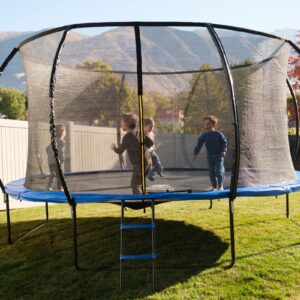
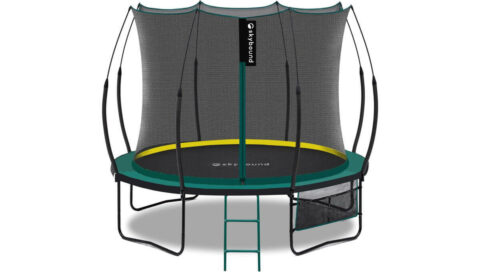
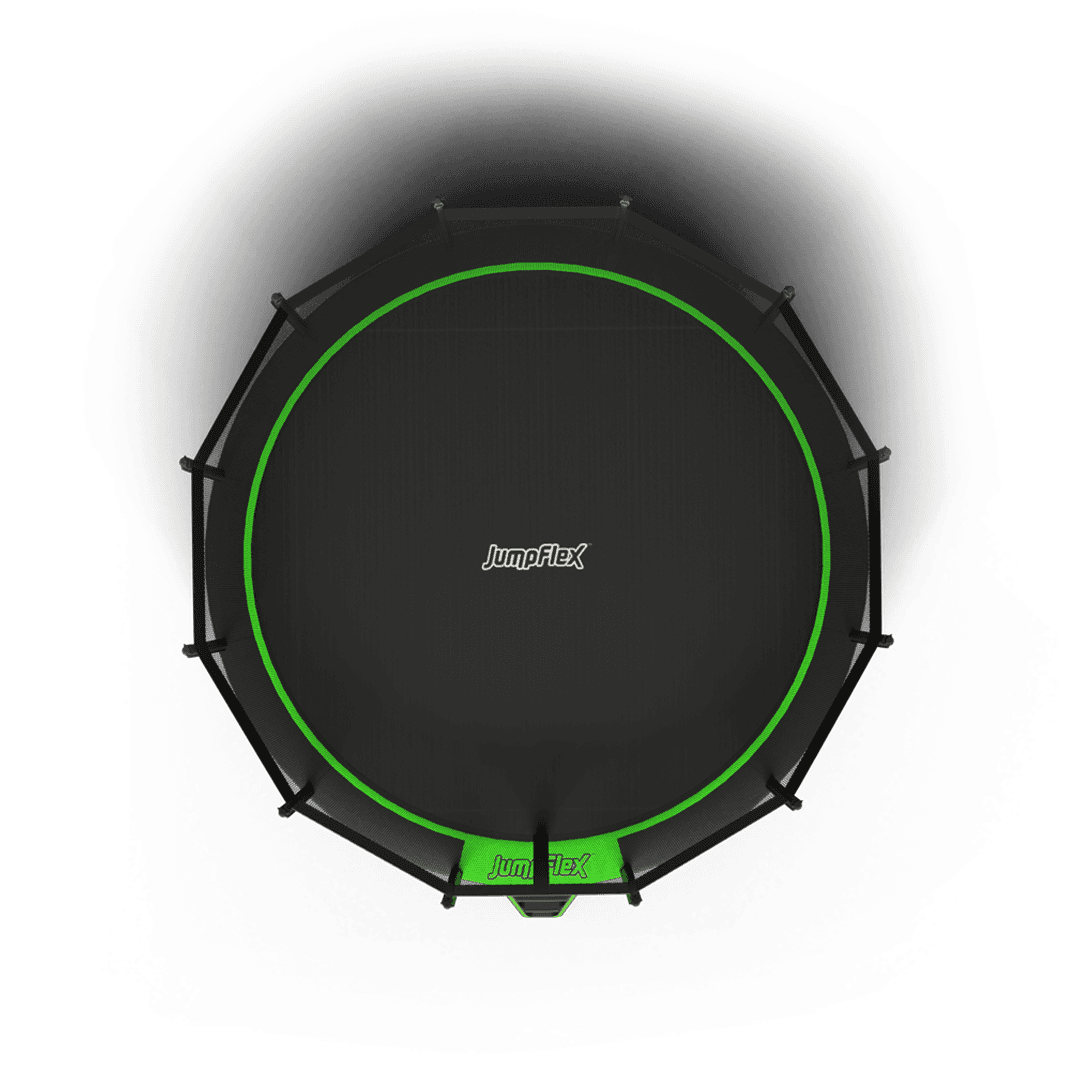
We’ll be straight, the way we try to be in every review: the HERO doesn’t try to turn heads. It’s a black-and-green round trampoline with a curved net and a ladder, restrained, equipment-like, the way most decent trampolines look. There’s no surprise there and no problem with it either. The design effort on this one went somewhere other than looks. It went into the frame.
That’s worth dwelling on, because the FrameFusion system is the reason the HERO exists as a distinct product rather than another mid-tier round. Jumpflex holds a patent on it. It won a Good Design Award. The DualRing layout, two separate steel rings running the perimeter (a 42 mm upper, a 38 mm lower) clipped together by the connectors, is pitched as adding lateral stability over a single-ring frame. So this is design thinking, just design thinking that’s gone into engineering rather than styling. The metalwork also gets a six-layer rust treatment, galvanized inside and out plus the powder coat on the visible parts, which is the kind of thing you appreciate three winters in.
Frame and Sturdiness
The frame is the whole story of this trampoline, and it deserves the honest treatment in both directions.
The good side first. FrameFusion is a real, award-winning innovation. Instead of bolting and welding the steel tubes together, the tubes snap into positive-lock T-joint connectors, so the whole frame goes together by hand. No bolts, no welds, no tools. That’s the reason Jumpflex can claim a roughly 20-minute build on a 14 footer, and that’s a genuine pain-point killer. Anyone who’s assembled a bolted 14ft frame knows exactly how much of an afternoon that eats. The Australian Good Design Award is verified; Jumpflex also describes the design as patented, though we couldn’t surface a filing in USPTO, NZ, or Australian patent databases (it may be pending, registered elsewhere, or trademark-only in practice). The DualRing tube diameters (42 mm and 38 mm OD) are published and respectable for the tier, the steel is high-tensile, and the whole thing is backed by a 10-year frame warranty.
Now the part you need to weigh. A snap-together frame is unconventional in this segment. The brands that have been around longest, the ACONs and the BERGs and the AlleyOOPs, all use bolted-and-welded construction, and they’ve got decades of field data behind those designs. Jumpflex has a couple of years in the US market. On top of that, it doesn’t publish the frame tube wall gauge. It publishes the outer diameters, but not the wall thickness, which is one of the better single indicators of how a frame will hold up over years of cycling. So a buyer here is weighing a genuinely clever frame design against two open questions: an unproven construction method and an unprinted wall thickness.
Jumpflex genuinely doesn’t print the wall thickness anywhere a buyer could find it. That said, the frame isn’t weak: the published outer diameters, the Good Design Award, the rust treatment, and the 10-year frame warranty all point the other way. On a frame design without a long track record, that 10-year warranty is the thing that actually protects you. Read it, keep it, and know what it covers.
Bounce and Springs
88 high-tensile extension springs, about 7.1 inches long, ringing the 12.1 ft jumping mat. Galvanized for rust resistance. On a 14ft round that’s a mid-tier setup: perfectly fine for what most families do on a trampoline, not a standout. For context, the ACON Air 14ft runs more springs at a longer length, and the AlleyOOP 14ft PowerBounce uses a roughly 96-spring dual-layer arrangement with adjustable firmness. The HERO has neither the spring count nor the tunability of those.
What it gives you is a stable, even, family-friendly bounce. The DualRing frame’s rigidity means the energy you put in mostly comes back as height rather than getting absorbed by frame flex, and the mat surface is generous enough for two kids to play games on (though, as on every trampoline, one jumper at a time is the rule that keeps people out of the ER, structural rating or not). If your buyers’ kids want to bounce, this delivers. If one of them wants to learn front flips, the bounce will feel shallow compared with a performance round, and that’s a fair trade for the price, not a flaw to apologize for.
Mat
UV-treated jumping mat, and here we hit one of those Jumpflex gaps. The brand doesn’t state the mat material on the product page, and it doesn’t publish the stitch-row count either. Polypropylene is the standard at this price point, so that’s our best read, but it’s an inference, not a printed spec. A buyer cross-shopping a mat with a stated material and a stated stitch-row count is comparing against numbers Jumpflex simply hasn’t given.
For what it’s worth, the net branding (the “TightWeave” polyester) is well documented; it’s the mat that isn’t. The mat warranty is 5 years per Jumpflex’s Australian site, which matches ACON’s 5-year mat cover and is at the better end of the residential tier; the actual fibre composition still isn’t on the page. None of this means the mat is bad. It means we can’t tell you how the material itself stacks up against a published-spec rival, and at this price you ought to be able to look that up.
Safety, Enclosure and Padding
The usual caution, because it doesn’t stop being true no matter how well a trampoline is built: trampolines carry injury risk, supervision and one-jumper-at-a-time are on you and not on the equipment, and the 550 lb structural rating is not an invitation to put four people on it. Jumpflex, like every responsible manufacturer, recommends a single jumper at a time.
That said, the enclosure on the HERO is genuinely one of its stronger pieces. The net is 100% high-strength polyester with a UV additive, the poles are curved so they lean away from the jumping area rather than standing straight up where a flailing limb would find them, the poles are foam-sleeved, and the entrance is a self-closing zip Jumpflex calls SafeSeal. That’s a thoughtful net package, the kind of thing that’s a step above the loose, pole-cover-dependent nets we’ve complained about elsewhere. The one knock is the same Jumpflex pattern: the pole count isn’t published. We score the enclosure in the low 70s, which is the highest component score on this trampoline, with the undisclosed pole count keeping it from going higher.
The safety pad is included, sitting over the spring zone the way it should, but Jumpflex doesn’t publish its thickness or its material. The pad is the part of any trampoline most likely to wear out first under sun and weather, so budgeting for a replacement somewhere around the 2-to-4-year mark is just realism. We’d love to tell you how thick this one is. We can’t, because Jumpflex doesn’t say.
What’s in the Box
You get everything you need to build it and use it, with no surprise add-on costs. The DualRing frame and its FrameFusion connectors, the jumping mat, all 88 springs, the safety pad, the full net enclosure (poles and netting both), the ladder, and an assembly manual. The whole thing ships in 3 boxes at roughly 252 lbs total, so expect a delivery that takes up the garage for a day or two and a couple of trips to carry it round the back.
The “included” part matters more than it sounds. On a fair number of 14ft trampolines the net is a separate purchase that quietly adds $100 to $200, and the ladder is often extra too. On the HERO they’re both in the box. We’ll fold that into the value discussion below, because it changes the comparison.
Assembly
This is the headline feature, so it gets the room. The pitch is about 20 minutes with two people, no tools at all, and the no-bolt FrameFusion frame is what makes that even plausible. Tubes snap into the T-joint connectors by hand, the rings clip together, and you’re not crawling around the lawn hunting for a 13 mm socket halfway through. Compared with a bolted 14ft frame, which is genuinely the better part of an afternoon and a sore back, that’s a meaningful difference, and it’s the single best practical reason to choose the HERO over a Zupapa or a Jumpzylla.
Be realistic, though. Budget more than 20 minutes for a first build. The frame itself does snap together fast, but the net enclosure, as on every netted trampoline ever made, is where the time goes: threading poles, tensioning the netting, fitting the foam sleeves, attaching the zip entrance. None of that is hard, but it’s fiddly and it takes a while, and “20 minutes” is the frame, not the whole job. Pick the final spot before you start, get a second adult, do the frame, then settle in for the net. You’ll still be done in a fraction of the time a bolted trampoline takes, and you won’t have lost any hardware in the grass, because there isn’t any.
Who This Is For
- Assembly-averse buyers. Anyone who’s dreaded the “bolt 90 springs and a 14ft steel ring together” Saturday. The tool-free FrameFusion build is the single best reason to pick this over a cheaper bolted round, and it’s not close.
- Mid-budget buyers who want it to feel premium. Around $900 on sale gets you the curved net, the included ladder, the award-winning frame design, and a 10-year frame warranty. That’s a real step up in feel from a $300-tier trampoline without the $1,200-plus of an ACON or an AlleyOOP.
- Big and mixed-age families. The 350 lb per-jumper limit is generous for a 14ft round and comfortably covers teenagers and parents, not just little kids. The 550 lb total structural rating means the frame itself isn’t fussy, though one jumper at a time is still the safe rule.
- Buyers willing to bet on a younger brand. Jumpflex has the Good Design Award and the warranty. What it doesn’t have yet is a decade of US field reviews. If that’s a fine trade for the design and the assembly, this is your trampoline.
Who This Is NOT For
- Spec-driven buyers who need a published frame wall gauge. Some competitors publish frame tube wall thickness; Jumpflex doesn’t. If hard, verifiable frame numbers are how you decide, that gap will bother you.
- Anyone wary of an unconventional frame. A no-bolt, no-weld snap-together frame is clever and award-winning, but it isn’t the proven-for-decades welded-and-bolted construction the established premium brands use. If you want the boring, known-quantity frame, look at the ACON Air 14ft, the AlleyOOP 14ft, or a bolted Zupapa.
- Serious athletic bouncers. 88 springs at about 7.1 inches is family-grade rebound, not the deep, responsive bounce of an ACON Air or an AlleyOOP PowerBounce. If you want performance bounce, those are the picks.
- Bounce-per-dollar shoppers. A Zupapa or a Jumpzylla 14ft gives you more trampoline for a third to a half of the price, if you don’t mind spending an afternoon bolting it together and living with a shorter-feeling warranty.
- Buyers who need a specific ASTM standard number documented. Jumpflex says “ASTM-certified” without citing the standard. If you need that in writing for a school or an insurer, ask Jumpflex directly before buying.
How It Compares
| Factor | Jumpflex HERO 14ft | Zupapa 14ft Round | ACON Air 14ft Round | AlleyOOP 14ft PowerBounce |
|---|---|---|---|---|
| Tier / price | Upper-mid (~$900 sale / $1,199 list) | Value (~$300-450) | Premium (~$700-1,000) | Top-tier (~$1,000-1,400) |
| Spring system | 88 springs, ~7.1 in, fixed | ~96 springs, fixed | 96 springs, 8.5 in, fixed | ~96 dual-layer, 3 adjustable settings |
| Frame | FrameFusion no-bolt DualRing, tool-free build | Bolted and welded | Bolted and welded, galvanized | Bolted and welded |
| Per-user weight limit | 350 lb (550 lb total structural) | ~375-425 lb total | No single-user limit (structural ~1,650 lb) | ~350 lb per jumper |
| Net + ladder included? | Yes, both in the box | Yes | Yes | Yes |
| Frame warranty | 10 years | ~10 years | 10 years | Lifetime frame |
| Frame gauge published? | No | No | No | No |
| Best for | Fast tool-free build, premium feel on a mid budget | Most bounce per dollar | Deepest published spec sheet, long track record | Tunable bounce, lifetime frame |
| PT review | This page | Zupapa 14ft review | ACON Air 14ft review | AlleyOOP 14ft PowerBounce review |
The HERO’s pitch against that field is “premium-feeling design and a near-instant tool-free build, at a price that undercuts the established premium players.” It earns that against the Zupapa 14ft review handily: better build feel, a longer-feeling warranty, and a build that takes a fraction of the time. The Zupapa fights back on pure bounce-per-dollar, and if all you care about is the most trampoline for the money and you’ll happily spend a Saturday bolting it, the Zupapa is the value play.
Against the ACON Air 14ft review, the HERO concedes ground. ACON costs about the same as the HERO or a bit more, has the deeper published spec sheet, and comes from a brand with a long track record, though it’s a conventional bolted-and-welded frame with the slower build that implies. If you want the deepest verifiable specs and a brand history measured in decades, the ACON. If you want the 20-minute build and don’t mind the shallower spec sheet, the HERO.
And the AlleyOOP 14ft PowerBounce review is the top of the market: tunable bounce stiffness across three settings, a lifetime frame warranty, and a price tag to match. If you want adjustable bounce and the longest warranty in the category, that’s the one, and the HERO doesn’t compete on either. The HERO’s answer is “most of the premium feel, the fastest build, and a few hundred dollars saved.” For a lot of buyers that’s the right answer. For a spec-driven or performance-driven buyer it isn’t.
If you’re cross-shopping shapes, our rectangular trampolines section has the premium rectangle picks (the ACON X 17ft is the standout there), and if you’re thinking about an in-ground install instead, the BERG Champion InGround 14ft is the one to look at. For everything else round, see the full round trampolines category, and our trampoline buying guide walks through how to pick a size and a frame in the first place.
The Price: Is It Worth It?
Here’s the value math. We couldn’t confirm a live Amazon figure, but across Jumpflex’s own store and a couple of third-party retailers the picture is steady: around $900 on sale, $1,199 at list. At the sale price, the HERO is a decent buy. You’re getting a 14ft round with the net AND the ladder already in the box (on a lot of competitors that’s $100 to $200 of add-ons you’d be paying separately), from a Good Design Award brand, with a 10-year frame warranty and a 20-minute tool-free build. That bundle slots neatly between Zupapa-tier value, which gets you more spring count for the money but a basic build and a shorter-feeling warranty, and ACON or AlleyOOP-tier premium, which gets you deeper specs and a longer track record for several hundred dollars more.
At the $1,199 list price the value case is thinner. You’re then paying close to ACON money for a trampoline with a shallower published spec sheet and a younger brand history, and the FrameFusion build, good as it is, doesn’t fully close that gap on its own. So the honest advice is the obvious one: watch for the sale. At roughly $900 the HERO is well-positioned. At $1,199 it’s overlapping with kit that out-documents it.
One more piece of honesty, the same one we put in every review where it applies: the HERO is designed in New Zealand and manufactured in China. Jumpflex’s design pedigree is real, the Good Design Award is real, and the brand’s quality oversight appears genuine. But if you’re shopping specifically for something built in NZ or Europe, know that the HERO is designed there and built elsewhere. We don’t think that’s a knock. We think you should hear it plainly.
Our Verdict
The Jumpflex HERO 14ft is a well-designed, fast-to-build, premium-feeling 14ft round at a mid-budget price, and the FrameFusion frame is a genuine innovation rather than marketing noise. The included net and ladder, the curved foam-sleeved poles, the self-closing zip entrance, the 350 lb per-jumper limit, the 10-year frame warranty, and especially the roughly 20-minute tool-free build add up to a trampoline that’s easy to recommend to the right buyer.
We score it 6.6 out of 10, and the limiting factor is the frame. Not because we think it’s weak, but because Jumpflex won’t publish the steel-tube wall gauge, the snap-together design is unconventional in a segment where the established brands all bolt and weld, and the brand hasn’t been in the US long enough to have a decade of field reviews behind it. Combined with the other undisclosed numbers (the mat fibre composition, the mat stitch-row count, the warranty year counts on the net and pad, the enclosure pole count, the ASTM standard number), there’s a pattern here: Jumpflex designs well and documents partially. The 10-year frame warranty is the real protection on the frame, so read it and keep it.
It’s not for everyone. If you need a published frame gauge, this isn’t your trampoline. If you want performance bounce, look at the ACON Air 14ft or the AlleyOOP PowerBounce. If you want the most bounce per dollar, the Zupapa 14ft. And if you need a certification standard number in writing, you’ll have to ask Jumpflex for it.
But if assembly hassle is the thing you most want to avoid, or you want a 14ft that feels a step up without the top-tier price, the HERO earns its place. Buy it on sale, around $900, read the warranty, and you’ve got a solid backyard trampoline that went together in the time it takes to watch a sitcom.
Frequently Asked Questions
Q: Is Jumpflex a good trampoline brand?
A: It’s a credible one, with a couple of caveats. Jumpflex is a New Zealand company that designs its trampolines in Hamilton and manufactures them in China, and the HERO line has won an Australian Good Design Award for its frame, which isn’t nothing. It shows up on most of the 2025 and 2026 “best 14ft trampoline” roundups, the warranties are reasonable (10 years on the frame), and the no-bolt FrameFusion assembly is a genuine selling point. The caveat is that Jumpflex only pushed into the US market in 2024 and 2025, so it doesn’t have the decade-plus of field reviews behind it that ACON, BERG, or Springfree do. If you’re comfortable with a younger brand that’s clearly putting effort into design and engineering, it’s a solid pick. If you want a name with a long, boring track record, that’s a different shortlist.
Q: What is the FrameFusion frame, and is a no-bolt frame as strong as a welded one?
A: FrameFusion is Jumpflex’s snap-together frame system, trademarked and used in their marketing as “patented” (we couldn’t verify the patent filing in USPTO, NZ, or Australian databases, so treat the patent language as the brand’s claim rather than something we independently confirmed; the verified credential is the Australian Good Design Award). Instead of bolting and welding the steel tubes together, the tubes snap into positive-lock T-joint connectors, so the whole frame goes together by hand with no tools, no bolts, and no welds. It’s the reason a 14ft HERO can be assembled in about 20 minutes by two people. As for strength: Jumpflex builds the frame from two rings of high-tensile steel (a 42 mm upper and a 38 mm outer diameter) in a DualRing layout, gives it a six-layer rust treatment, and backs it with a 10-year warranty, so it isn’t a corner-cutting move. But honestly, a snap-together frame is unconventional in this segment, the brands that have been around longest all use bolted-and-welded construction, and Jumpflex doesn’t publish the tube wall gauge, so we can’t fully verify the frame on paper. We score the frame component conservatively and flag the gap right in the review. The 10-year warranty is your real protection there, so read it and keep it.
Q: How long does the Jumpflex Hero 14ft take to assemble?
A: Jumpflex says about 20 minutes with two people and no tools at all. That’s the headline benefit of the FrameFusion frame, and the frame itself genuinely does snap together fast. Be realistic, though, and budget more than 20 minutes for a first build, because the net enclosure (as on every netted trampoline) takes longer than the frame: threading poles, tensioning netting, fitting foam sleeves, attaching the zip entrance. So “20 minutes” is the frame, not the whole job. Even so, compared with a bolted 14ft frame, which is usually the better part of an afternoon, it’s a meaningful difference, and you’re not hunting for a lost socket halfway through because there’s no hardware to lose.
Q: What’s the weight limit on the Jumpflex Hero 14ft?
A: There are two numbers, and they mean different things. The maximum individual user weight is 350 lbs, which is generous for a 14ft round (a lot of competitors cap individual jumpers at 220 to 330 lbs). The total structural weight rating is 550 lbs, which is the frame’s overall load capacity, not a per-person figure. So one jumper up to 350 lbs is fine, and the frame itself won’t complain about more weight than that on it, but, as with every trampoline, one jumper at a time is the safe rule regardless of what the structural rating says.
Q: Does the Jumpflex Hero 14ft come with a net and ladder?
A: Yes, both are in the box. The HERO 14ft ships with the full safety net enclosure (curved poles that lean away from the jumper, foam sleeves, a self-closing zip entrance) and a ladder, included, not as separate add-ons. That’s worth factoring into the price comparison, because on some 14ft trampolines the net is a separate purchase that adds $100 to $200, and the ladder is often extra too, so the HERO’s sticker price already covers things you’d be paying more for elsewhere.
Q: Jumpflex Hero vs Zupapa or ACON, which 14ft should I buy?
A: It comes down to budget and what you value. A Zupapa 14ft is a third to a half of the Jumpflex’s price and gives you more spring count for the money, but you’ll spend an afternoon bolting it together and the build feels more basic. An ACON Air 14ft costs about the same as the Jumpflex (or a bit more), has the deepest published spec sheet in the category, and comes from a brand with a long track record, but it’s a conventional bolted-and-welded frame with a slower build. The Jumpflex Hero sits in between: nicer feel and a far faster, tool-free build than the Zupapa, at a price that undercuts the AlleyOOP-tier premium, but with shallower published specs and a shorter brand history than the ACON. If assembly hassle is what you most want to avoid, the Jumpflex. If you want the deepest verifiable specs and the longest track record, the ACON. If you just want the most bounce per dollar, the Zupapa.
Product Photos
Price History
Price history (Amazon, last checked 24 Oct 2026, 15:15 UTC)
Get notified when the price drops
Set a target price and we'll email you when it's reached.