JumpYeti 14ft Round Outdoor Trampoline Review (2026)
Check price on AmazonProduct prices and availability are accurate as of the date and time indicated and are subject to change. Any price and availability information displayed on Amazon.com at the time of purchase will apply to the purchase of this product.
Limiting: Springs (58/100)

PT Score Breakdown
How we calculate PT Scores →Pros and Cons
Pros
- Genuinely low price for a 14 ft round (around $449 on Amazon), about half the Jumpflex HERO 14ft on sale and similar to Zupapa-tier pricing
- Complete-in-the-box bundle: full safety net enclosure and ladder included (vs cheaper Amazon listings where the net is a $100-200 add-on)
- Real brand with a Utah HQ and customer-service pages on jumpyeti.com, not an anonymous dropship rebrand; stocked by independent distributors (trampolines.com, River City Play Systems) as well as Amazon
- Galvanized steel frame with a powder coat over it (the standard rust-resistance combination for an outdoor trampoline)
- "ASTM Approved" stated on the Amazon listing title (specific standard number not cited)
Cons
- Warranty is 1 year across the ENTIRE product (frame, springs, mat, pad, net), with no component breakdown; this is the shortest cover in the segment by a wide margin (ACON gives 10 yr frame, Jumpflex 10 yr, BERG 10-13 yr, Galactic Xtreme LIFETIME on frame and springs)
- The "40 percent thicker than standard" Amazon listing claim does NOT survive verification: no reference gauge is named, no actual JumpYeti gauge is published anywhere on jumpyeti.com or in their blog posts; treat as marketing copy not a spec (parallel to the Galactic Xtreme "piano-wire" myth we debunked)
- Spring count, spring length, and spring type are all unpublished, so there is no way to judge the rebound before the trampoline arrives; the springs are the thinnest part of an already-thin spec sheet
- JumpYeti publishes almost none of the rest of the spec sheet either: no frame tube diameter or wall gauge, no mat material, stitch count, pad thickness, net pole count, or entry style; you are buying on price and the brand's word
- Per-jumper individual weight limit not broken out: JumpYeti gives a single ambiguous 450 lb figure (most safely read as total/structural rather than per-person)
- No verified track record: the 2024-2025 US Amazon entry is too recent to have a decade of field reviews, and the "USA Today pickup" sometimes cited for the brand does not check out; country of manufacture is not stated either
- At a similar price the Zupapa 14 ft publishes more of its spec sheet (spring count at minimum) and has a thicker Amazon review base, so the JumpYeti loses the cross-shop to Zupapa on transparency
Full Review
PT Score: 5.8 / 10
This is the lowest score we’ve issued in this rectangular-and-round review run, and we want to explain why right up front instead of burying it 600 words in. Our methodology rewards what brands actually publish. JumpYeti publishes almost nothing. They give you a single weight number, a one-year warranty, an “ASTM Approved” claim without a standard number, and an Amazon listing line about the frame being “40 percent thicker than standard” without ever saying what the standard is or what their own gauge actually is. There’s no spring count, no spring length, no spring type, no frame tube OD, no frame wall gauge, no mat material, no stitch row count, no safety pad thickness, no net pole count, no per-jumper weight limit, and no country of manufacture. So the score is 5.8 out of 10, with springs as the limiting factor, and that isn’t us being harsh. It’s the methodology doing its job.
JumpYeti’s pitch is genuinely the price. Around $449 on Amazon for a 14ft round with the net AND the ladder in the box, from a brand that has its own website and a Utah HQ rather than being a faceless dropship. That’s a real proposition for a buyer who’s done the math and decided they’re knowingly paying for an opaque spec sheet to save a few hundred dollars. The trampoline exists, it works, the company will answer a support email. What the trampoline isn’t is verifiable, and at this price tier there are competitors who’ll show you their numbers. The honest read on this product is the read most affiliate sites won’t write: it’s a fine cheap trampoline if you go in with eyes open about what you can’t check.
Key Specifications
| Specification | Detail |
|---|---|
| Shape | Round |
| Nominal size | 14 ft |
| Total weight capacity | 450 lbs (single number; JumpYeti doesn’t split per-jumper vs structural) |
| Per-jumper individual limit | Not published by JumpYeti |
| Frame material | Galvanized steel, powder coated |
| Frame tube outer diameter | Not published |
| Frame tube wall gauge | Not published (Amazon listing says “40 percent thicker than standard” without naming the standard or stating the actual gauge) |
| Spring count | Not published |
| Spring length | Not published |
| Spring type | Not published |
| Jumping mat material | UV-resistant (polypropylene inferred; not stated by JumpYeti) |
| Mat stitch rows | Not published |
| Safety pad | Included; thickness, width, and foam type not published |
| Net material | UV-resistant polyethylene (per a JumpYeti blog post, not the product spec) |
| Net pole count | Not published |
| Net entry style | Not published |
| Ladder included | Yes (visible in the hero image) |
| Certification | “ASTM Approved” stated on the Amazon listing title; specific standard number not cited |
| Warranty (entire product) | 1 year, no breakdown by component |
| Assembly time | “An hour or two” (a marketing line from JumpYeti’s own blog, not a timed claim) |
| Age range | Not published |
| Country of manufacture | Not published |
| In the box | Frame, mat, safety pad, net enclosure, ladder, hardware, manual |
| Price | Check current price |
A note on the price line. JumpYeti lists the 14ft at around $449 on its own jumpyeti.com store, and Amazon tracks that figure closely. We’re not quoting a precise live number because the stock signals are mixed (jumpyeti.com showed the 14ft sold out at our research date; the trampolines.com mirror showed 5-to-7-day delivery), and a stale figure is worse than tier language. The practical takeaway is that this is a low-to-mid budget 14ft round, roughly half the price of the Jumpflex HERO 14ft on sale and similar Zupapa-tier pricing. We’ll come back to the value math at the end.
Who Is It For?
Picture the buyer who’s already decided the budget. They want a 14ft round for the kids, the upper end of what they’re willing to spend is around $500, and they’ve narrowed it down to a couple of options on Amazon that all look broadly similar in the listing photos. They’re not running a spreadsheet of spring counts. They’re trying to decide which of the cheap-ish 14fts to put in their cart. The JumpYeti is positioned for that buyer. It’s a real brand, with its own .com site and customer service, which is more than the bottom-tier no-name listings give you. The price is genuinely lower than the Jumpflex, the ACON, or anything else with comparable build documentation. And the package is complete in the box (net and ladder both included), so there’s no $100 surprise when the box arrives.
What it isn’t is a trampoline whose specs you can verify. If you’re the kind of buyer who’d open three browser tabs to compare spring count and frame gauge across competitors, you’ll close JumpYeti’s tab first because there’s nothing to compare. The brand publishes one weight number (450 lbs), one warranty number (1 year), one material descriptor for the frame (“galvanized steel”), and one for the mat (“UV-resistant”). That’s it. So this is either fine because you weren’t going to check anyway, or it’s a deal-breaker because checking is how you decide. Both are reasonable positions. We just want you to know which one you’re in before you click buy.
Design
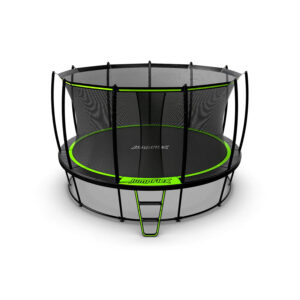
We’ll be straight, the way we try to be in every review: the JumpYeti doesn’t try to turn heads, and there isn’t much design language to talk about either way. It’s a black-frame round trampoline with a blue safety pad and a curved net, restrained, equipment-like, indistinguishable from a dozen other sub-$500 14ft rounds at twenty paces. The hero image on jumpyeti.com shows it set up in a Utah backyard with mountains in the distance, which is a nice photograph, but the trampoline itself is the trampoline itself. That’s not a knock. It’s just that there’s no patented frame system to point at, no design award to mention, and no styling signature. The product is what’s in the box, and the box contains a competent-looking 14ft round.
Frame and Sturdiness
This is the section where every other review we’ve published this run gets to talk about a published frame gauge or at least a published outer diameter. JumpYeti gives us neither. The product is “durable galvanized steel,” powder coated, and that’s where the documentation ends. So the section has to be about what we can verify and what we can’t.
What’s verifiable: the frame is galvanized steel with a powder coat over it, and powder coat on galvanized steel is a sensible rust-resistance combination for an outdoor product that’s going to live in weather for years. JumpYeti’s hero photo shows the customary black powder-coated curved-leg design that’s standard on round trampolines at this price tier. The brand is real, the HQ is in Salt Lake City, and the trampoline gets sold through three channels we could verify (jumpyeti.com, Amazon, and trampolines.com), which together suggest the product actually ships when you order it.
What isn’t verifiable: the actual frame steel-tube gauge. The Amazon listing says the frame is “engineered 40 percent thicker than standard for rust resistance and stability in all weather.” This is the kind of phrase that sounds like a specification until you ask the obvious follow-up: 40 percent thicker than what, exactly? JumpYeti doesn’t say. There’s no reference gauge named anywhere in the listing copy, on JumpYeti’s own product pages, or in any of their blog posts. JumpYeti’s product pages publish zero actual frame thickness numbers. The frame has the rust treatment a real outdoor trampoline needs, and there’s a genuine manufacturer behind it, but the steel-tube gauge and the outer diameter are both absent. The “40 percent thicker” line is marketing copy, not a spec, and we’ll come back to it in the FAQ.
For context, when Galactic Xtreme publishes a 3.0 mm frame gauge (9 gauge, hot-dipped galvanized), they’re giving us a number that survives scrutiny. When Jumpflex publishes 42 mm and 38 mm outer diameters on their DualRing frame, they’re giving us numbers. “40 percent thicker than standard” is a comparison without a standard, and on a trampoline that’s going to be carrying jumping kids for years, the buyer deserves a number that isn’t relative.
Bounce and Springs
The springs are the weakest part of this trampoline on paper, and the reason is simple. Every part of the spring system on the JumpYeti is unpublished. We don’t know how many springs there are. We don’t know how long they are. We don’t know whether they’re standard galvanized coil, heavy-duty coil, or some marketing-branded variant. The product page describes the springs by their existence and nothing else.
And these specs genuinely aren’t published anywhere a buyer could find them, not on the product page, the distributor listings, or anywhere else. The marketing language is “heavy-duty,” “high-tension,” and “jam-resistant,” all adjectives rather than numbers. The omission is consistent and looks deliberate.
For comparison, the Jumpflex HERO 14ft publishes 88 springs at about 7.1 inches each. The Galactic Xtreme rectangles publish 124 springs at 9 inches. The ACON Air 14ft publishes 96 at 8.5 inches. The Zupapa 14ft publishes about 96. JumpYeti gives us none of those numbers. That blank is what keeps the overall score at 5.8. If JumpYeti ever publishes a spring count and length, we’ll happily revisit it. Until then, a buyer is committing to a rebound they can’t preview on paper.
The practical implication for a buyer: you can’t know in advance how the trampoline will feel to bounce on. Spring count and length are the two biggest determinants of rebound depth and stiffness, and without them, the only way to learn is to set it up and try it. That’s a worse position than a buyer of a Jumpflex or a Zupapa, both of whom can read the numbers before they commit.
Mat
UV-resistant jumping mat, and we run into the same JumpYeti pattern: the brand doesn’t actually state the mat material on the product page, and they don’t publish the stitch-row count either. Polypropylene is the industry standard at this price point, so it’s our best read, but it’s an inference, not a published spec, and we’ll say so plainly. It’s the same JumpYeti pattern as the frame and the springs: the material a buyer would want to compare simply isn’t on the page.
The mat is “UV-resistant,” which is the standard one-word descriptor and tells you the material has some additive to slow sun damage. What we’d want to know, and don’t: the polymer (PP vs PE, both common), the weave density, and the stitch row count along the perimeter (typically eight rows on standard mats, ten on premium). None of those numbers is on JumpYeti’s site. The mat is “covered” under the one-year warranty, which is the next section.
The Warranty Is Short, Period
This is the most material weakness on the product, and we’re giving it its own section because it deserves one. JumpYeti’s warranty is one year, on the entire product. Not one year on the consumables and ten on the frame. Not five and five and one. One year, flat, across the frame, the springs, the mat, the safety pad, and the net.
The context matters. Every other trampoline in this segment, premium or mid-tier, gives at least ten years on the frame. ACON gives 10/5/5/2/1. BERG gives 10-to-13 on the frame, 5 on the springs, 2 on the mat and pad and net. Jumpflex gives 10 on the frame. The Galactic Xtreme 10×17 gives LIFETIME on the frame and LIFETIME on the springs, with 2 years on consumables. JumpYeti’s 1-year cover across everything is the shortest warranty in the entire segment. It is not in the same league as the brands you’d be cross-shopping at any price tier above the very-cheapest no-name Amazon listings.
The one-year warranty is the weakest thing about this trampoline, and it’s worth being blunt: a budget-tier warranty signals how much risk JumpYeti is willing to carry on its own product, and one year is not much. If you care about long-term cover, this is a deal-breaker. If your plan is “buy a cheap-ish 14ft, use it for three to five years, replace it when the kids get bored,” then the one-year warranty matters less. Just know which buyer you are.
What’s in the Box
The package is complete: frame, mat, safety pad, net enclosure, ladder, hardware, manual. The hero photo confirms the ladder (a blue 3-rung visible at the entrance), and JumpYeti’s own product page lists the safety net and the safety pad as included. That matters more than it sounds. On a fair number of sub-$500 Amazon trampolines, the net is a separate purchase that quietly adds $100, and the ladder is often extra too. JumpYeti includes both, and we’d encourage you to factor that into the price comparison.
What we don’t know about what’s in the box: the net pole count, the pole material gauge, the pole entry style (zip, buckle, both, or neither), or the specific mesh material beyond the UV-resistant polyethylene line in JumpYeti’s blog (which isn’t on the spec sheet). The pad is included; its thickness and material aren’t published. The ladder is included; its height and material aren’t published either. So the bundle is real, but the parts inside the bundle are mostly stated by existence rather than by spec.
Assembly
JumpYeti’s marketing line is “an hour or two.” That’s a phrase, not a timed claim, and it appears in a blog post rather than on the spec sheet. We have no independent timing of the actual build because there’s no published account from JumpYeti or from third-party reviewers that we could verify. So the honest answer on assembly is: probably standard for a bolted 14ft round, which is genuinely the better part of an afternoon with two adults, and there’s no indication JumpYeti uses any kind of tool-free system like Jumpflex’s FrameFusion. Budget the afternoon. Get a second adult. Have a socket set handy. None of that is unusual for a trampoline in this price range; it’s just not anything special either.
How It Compares
This is the section that matters most for a buyer, because the JumpYeti only really makes sense against its peers.
| Factor | JumpYeti 14ft | Jumpflex HERO 14ft | Zupapa 14ft | ACON Air 14ft |
|---|---|---|---|---|
| Tier / price | Budget-low (~$449) | Mid (~$899 sale / $1,199 list) | Value (~$300-450) | Premium (~$700-1,000) |
| Spring count + length | Not published | 88 springs, ~7.1 in | ~96 springs (published) | 96 springs, 8.5 in (published) |
| Frame disclosure | “40% thicker than standard” (Amazon copy only; no reference number) | 42 mm and 38 mm tube ODs published; wall gauge not published | Wall gauge not published | Wall gauge not published |
| Per-jumper weight limit | Not published (single 450 lb total figure) | 350 lb per jumper (550 lb total structural) | ~375-425 lb total | No single-user limit (structural ~1,650 lb) |
| Net + ladder included? | Yes, both in the box | Yes, both in the box | Yes | Yes |
| Frame warranty | 1 year (entire product) | 10 years | ~10 years | 10 years |
| Best for | Buyers who knowingly trade specs for price | Assembly-averse mid-budget buyers | Most bounce per dollar at low price | Deepest published spec sheet |
| PT review | This page | Jumpflex HERO 14ft review | Zupapa 14ft review | ACON Air 14ft review |
The head-to-head that actually matters is the Jumpflex HERO 14ft review. Both are new-brand mid-budget 14ft rounds with the net and the ladder included, and the comparison is the one a real buyer is going to make. JumpYeti wins on price: ~$449 against ~$899 on sale, roughly half the cost. Jumpflex wins on almost everything else verifiable. Spring count: 88 published vs unpublished. Spring length: 7.1 inches published vs unpublished. Frame: published 42 mm and 38 mm tube ODs (still no wall gauge, but at least the OD numbers exist) vs an Amazon marketing line with no reference. Weight: 550 lbs total and 350 lbs per jumper, broken out cleanly, vs a single ambiguous 450 lb figure. Warranty: 10 years on the frame vs 1 year on everything. Frame technology: patented FrameFusion no-bolt snap-together with a Good Design Award, vs conventional bolted construction. Build time: about 20 minutes tool-free vs probably the better part of an afternoon. The choice between these two isn’t “which is better.” It’s whether you’ll pay roughly twice as much for a trampoline whose specs you can read.
The Zupapa 14ft review is the comparison that’s actually uncomfortable for JumpYeti, because Zupapa lands at similar pricing (~$300-450) and publishes more. Zupapa tells you it’s about 96 springs. That’s one published number more than JumpYeti gives you. The frame gauge is also unpublished on Zupapa, but the brand has been on Amazon for longer with a thicker review base, and the trampoline-per-dollar arithmetic works out at least as well as JumpYeti’s does. If you’re going to spend around $400 on a 14ft round, Zupapa is the brand that’s already proven the formula. The JumpYeti’s advantage over a Zupapa is “JumpYeti has its own .com site.” That’s not nothing, but it’s not much either.
The ACON Air 14ft review is the premium comparator, useful here as a reference for what a 14ft with a deep published spec sheet looks like. ACON costs roughly twice the JumpYeti, has 27 years of brand history, runs 96 springs at 8.5 inches (both published), and gives 10 years on the frame. The Air 14ft and the JumpYeti aren’t really in the same conversation: they’re for different buyers at different budgets. We mention it because if your price ceiling is genuinely $1,000 rather than $500, the ACON is the answer to “what does a verifiable 14ft round look like.”
If you want the same value-versus-spec calculation in the rectangle category, the Galactic Xtreme 10×17 is the parallel reference point: a brand that publishes its frame steel-tube gauge (3.0 mm) at a similar value price, and demonstrates what’s possible when a budget brand actually documents itself. Or for anyone cross-shopping the AlleyOOP 14ft PowerBounce, that’s the top of the round market, lifetime frame warranty, tunable bounce, and a different conversation entirely. For everything else round, our round trampolines category page has the full set, and our trampoline buying guide walks through how to pick a frame and a size in the first place.
The Price: Is It Worth It?
Here’s the value math. JumpYeti lists the 14ft at around $449. The Amazon price tracks that. For that money you get a complete 14ft round in the box (frame, mat, pad, net, ladder), from a real brand with a Utah HQ, a powder-coated galvanized steel frame, a one-year warranty across the whole product, and an “ASTM Approved” claim without a standard number. What you don’t get is published spec data on any of the components beyond the existence of those components. So the value calculus is asymmetric: you’re paying for what’s in the box and the brand backing, not for what’s verifiable on paper.
Against a Zupapa at a similar price the math is uncomfortable, because Zupapa publishes more. Against a Jumpflex HERO at twice the price the math depends entirely on whether you’d pay $450 more for a verifiable spec sheet and a 10-year frame warranty, or save the money and accept a one-year warranty and a blank spec sheet. Both positions are defensible. The buyer who already knows their answer doesn’t need us. The buyer who’s wavering should write down what matters: if it’s the price, JumpYeti is fine; if it’s the specs or the warranty, look at the Jumpflex.
Value is where the JumpYeti does best. It’s earned by the genuinely low price and the complete-in-the-box bundle, and held back by the one-year warranty and by how little of the spec sheet you can check before buying.
Our Verdict
The JumpYeti 14ft is a real trampoline from a real brand at a genuinely low price, and the spec sheet is mostly blank. We score it 5.8 out of 10, the lowest score in this review section, with springs as the limiting factor because every part of the spring system is unpublished. That score is honest: our methodology rewards what brands actually publish, JumpYeti publishes very little, and the result is a low number that the company could move tomorrow by putting a spring count and a frame gauge on their product page.
It isn’t for everyone. If you compare frame gauges and spring counts, JumpYeti gives you nothing to compare. If you want long-term warranty cover, the one-year-on-everything cover is the shortest in the segment. If you’d be making the buying decision on the “40 percent thicker” claim, that phrase is marketing copy and not a spec, and you should ask JumpYeti directly for the actual frame gauge before you commit. If you’ve got a heavier teenager or an adult who’ll be jumping, the unsplit 450 lb total figure makes it hard to know what JumpYeti expects an individual to weigh. And if bounce quality matters to you, without a published spring count or length, we can’t tell you anything useful about how this trampoline will feel.
But for the price-conscious buyer who’s done their homework, knows they’re not getting deep documentation, has decided that’s an acceptable trade for a sub-$500 14ft round with the net and ladder in the box, and won’t lose sleep over the one-year warranty because they’re planning to replace the trampoline in three to five years anyway, this is a defensible buy. Buy it on Amazon, expect a normal bolted-frame Saturday-afternoon build, register the warranty the day it arrives, and have realistic expectations. It’s not a bargain in the sense of “the same specs for less”; it’s a bargain in the sense of “less money for less to verify.”
Frequently Asked Questions
Q: Is JumpYeti a good trampoline brand?
A: It’s a real brand, and the trampolines exist and function. That’s not a low bar; some sub-$500 Amazon trampolines are dropship-rebrand listings from anonymous companies with no support, and JumpYeti isn’t one of those. It’s a Salt Lake City company that designs and sells its trampolines through Amazon and its own jumpyeti.com site, has customer-service pages, has a growing review base, and gets stocked by independent distributors like trampolines.com and River City Play Systems. What it doesn’t have, as of this writing, is the disclosure depth you’d find on a Jumpflex, an ACON, or a Galactic Xtreme. JumpYeti publishes no spring count, no spring length, no frame gauge, no per-jumper weight limit, and a 1-year warranty across the whole product. For a buyer who’s knowingly choosing price over specs, that’s a defensible trade. For a buyer who wants to verify what they’re getting, it isn’t enough information.
Q: Is the JumpYeti frame really “40% thicker”?
A: That phrase appears in the Amazon listing copy, and it’s the kind of statement that sounds like a spec until you ask the obvious follow-up: 40 percent thicker than what, exactly? JumpYeti doesn’t say. There’s no reference gauge given in the marketing language, and the brand publishes no actual frame wall-gauge number anywhere on its own product pages or in any blog post. We checked, and we checked broadly: the Amazon listing itself, JumpYeti’s 14ft product page, every blog post on jumpyeti.com, both US distributor listings (Trampolines.com and River City Play Systems), third-party review sites, and the USPTO patent and trademark databases. The number isn’t anywhere. “40 percent thicker than standard” is a comparison without a standard. Until JumpYeti publishes a number we can verify, treat the “40 percent thicker” line as marketing copy, not a spec. If frame gauge matters to you, the Galactic Xtreme 10×17 publishes theirs (3.0 mm, 9 gauge) right on the listing, and so does the AlleyOOP PowerBounce (2.5 mm). Those are numbers you can compare. JumpYeti’s isn’t.
Q: What’s the actual weight limit on the JumpYeti 14ft?
A: JumpYeti gives one number: 450 lbs. They don’t break out a per-jumper individual limit separately from a structural total frame capacity, which most premium brands do. For comparison, the Jumpflex HERO 14ft says “550 lbs total / 350 lbs per individual jumper,” two distinct numbers with two distinct meanings. The ACON Air 14ft gives no single-user cap and rates the frame structurally at around 1,650 lbs. JumpYeti’s single 450-lb figure is most safely read as the total, meaning the frame’s overall load rating rather than what one person should weigh. As with any trampoline, one jumper at a time is the safe rule regardless of what the listing says.
One footnote worth a quick mention: at least one US distributor (River City Play Systems) lists the JumpYeti 14ft at 400 lbs total, against JumpYeti’s own 450 lbs. The 50-lb gap is small but it suggests the distributor may be carrying older spec data. Treat the brand’s own 450 lbs as the authoritative number, but if you’re sizing the limit tightly for a heavier teenager or adult, double-check the figure on the actual listing you buy from.
Q: What’s the warranty on the JumpYeti 14ft?
A: 1 year, on the entire product. That’s not 1 year on the consumables and 10 on the frame, the way ACON or Jumpflex structure their warranties; it’s 1 year, full stop, across the frame, the springs, the mat, the pad, and the net. For context, every other 14ft round trampoline in this price bracket and above gives at least 10 years on the frame; Galactic Xtreme gives lifetime on the frame and the springs at a higher price point. JumpYeti’s 1-year warranty is the shortest cover in the segment and the most material weakness on the product. If long-term cover matters to you, it’s a hard pass.
Q: JumpYeti 14ft vs Jumpflex HERO 14ft, which should I buy?
A: The Jumpflex is roughly twice the price (~$899 on sale vs ~$449), and it’s also clearly the better-documented trampoline. Jumpflex publishes spring count (88), spring length (7.1 inches), and frame outer diameters (42 mm and 38 mm DualRing), uses a Good-Design-Award-winning no-bolt FrameFusion frame, builds tool-free in about 20 minutes, gives 10 years on the frame, and breaks its weight numbers out clearly (550 lbs total / 350 lbs per jumper). JumpYeti gives a lower price and a 1-year warranty, with most of the spec sheet blank. So: if your budget genuinely caps at ~$450 and you’re knowingly choosing price over specs, JumpYeti is the cheap option. If you can stretch to $899 on sale and you want a trampoline whose numbers you can actually read, the Jumpflex is the more honest buy.
Q: Does the JumpYeti 14ft come with a net and ladder?
A: Yes, both are in the box. The Amazon listing title spells out the safety enclosure, the weather-resistant mat, and the safety pad as included; the hero image shows the ladder; and JumpYeti’s own product page confirms the bundle. That’s worth noting in a price comparison, because on some cheaper 14ft trampolines the net is a separate purchase that quietly adds $100 or so. JumpYeti includes it. What we don’t have for the net is the pole count, the pole material gauge, or the precise net mesh; JumpYeti doesn’t publish those.
Price History
Price history (Amazon, last checked 23 Oct 2026, 09:15 UTC)
Get notified when the price drops
Set a target price and we'll email you when it's reached.